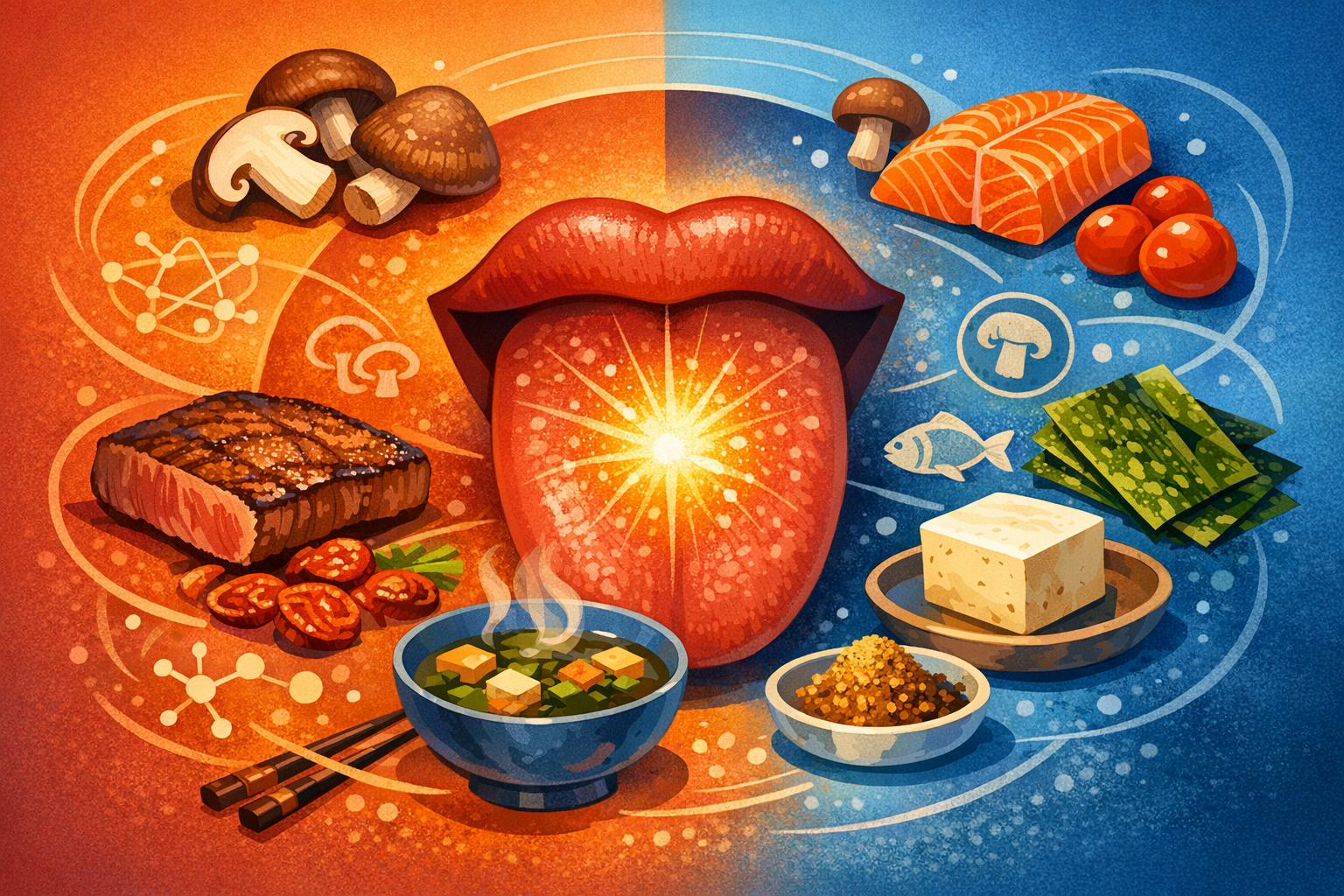
For most of culinary history, Western cooks operated with four tastes: sweet, sour, salty, and bitter. That framework felt complete enough. Until 1908, when a Japanese chemist named Kikunae Ikeda sat down to a bowl of dashi broth and asked a question nobody had bothered to formalize. The broth wasn't sweet. It wasn't sour. It wasn't salty or bitter. It was something else entirely. A deep, savory, mouth-coating richness that made him want to keep eating. He isolated the compound responsible (glutamic acid, found in the kombu seaweed used to make dashi), named the taste "umami", roughly meaning "pleasant savory taste", and filed a patent for monosodium glutamate the same year.
It took Western science nearly a century to catch up. Umami wasn't officially recognized as a distinct basic taste until 2002, when researchers at the University of Miami identified specific taste receptors on the human tongue dedicated to detecting glutamate. The delay wasn't because the science was complicated. It was because the idea of a fifth taste challenged centuries of European culinary assumption.
Today, understanding umami is one of the fastest ways to improve your cooking. It explains why Parmesan cheese makes everything better, why mushrooms add depth to vegetarian dishes, why a splash of fish sauce transforms a Thai curry, and why the combination of tomatoes, garlic, and olive oil is one of the most satisfying flavor bases ever devised.
What Umami Actually Is (At the Molecular Level)
Umami is the taste of glutamate. Specifically, the L-glutamate form of the amino acid glutamic acid. When proteins break down through cooking, aging, fermentation, or drying, they release free glutamate molecules that bind to dedicated receptors on your tongue called T1R1 and T1R3. These receptors evolved to help us identify protein-rich foods, which is why umami-heavy foods tend to feel deeply satisfying and nourishing in a way that's hard to articulate.
But glutamate alone is only part of the story. In the 1950s, Japanese researcher Shintaro Kodama discovered that certain nucleotides, specifically inosinate (IMP) and guanylate (GMP), create a synergistic effect with glutamate. When glutamate and these nucleotides are present together, the perceived umami intensity multiplies by a factor of 7 to 8. Not adds. Multiplies.
This synergy explains countless classic flavor combinations that cooks have stumbled onto over centuries without understanding why they work. Italian soffritto (tomatoes plus garlic plus olive oil plus Parmesan) combines the glutamate in tomatoes and cheese with the nucleotides released during slow cooking. Japanese dashi combines glutamate from kombu with inosinate from bonito flakes. Chinese stir-fries combine soy sauce (glutamate) with dried shiitake mushrooms (guanylate). These pairings weren't designed in a lab. They were discovered in kitchens and passed down because they taste extraordinary.
The MSG Controversy (And Why It's Mostly Nonsense)
Monosodium glutamate is pure crystallized umami. Glutamic acid bound to a sodium ion for stability. It was widely used in American and European cooking throughout the mid-20th century until a 1968 letter to the New England Journal of Medicine from a doctor named Robert Ho Man Kwok described numbness and palpitations after eating Chinese food, coining the term "Chinese Restaurant Syndrome."
The backlash was immediate and lasting, but the science never supported it. Multiple double-blind, placebo-controlled studies, including a large one published in the Journal of Allergy and Clinical Immunology in 2000, failed to establish any consistent link between MSG consumption and adverse reactions. The FDA classifies MSG as "generally recognized as safe." The European Food Safety Authority reached the same conclusion.
What MSG is, functionally, is a seasoning tool. It adds umami the same way salt adds saltiness. A quarter teaspoon in a pot of soup or a stir-fry sauce adds savory depth without making the food taste "like MSG". It just makes it taste more like itself, the same way salt does. Professional chefs who claim they never use MSG often rely on ingredients that are effectively natural MSG delivery systems: Parmesan cheese (1,680 mg of free glutamate per 100g), soy sauce (900 mg), fish sauce (950 mg), and Worcestershire sauce.
The Umami Pantry: Ingredients Ranked by Glutamate Content
Not all umami sources are equal. Understanding which ingredients pack the most free glutamate per serving helps you build flavor more efficiently.
The Heavyweights (Over 1,000 mg per 100g)
Aged Parmesan cheese sits at the top of the Western pantry with roughly 1,680 mg of free glutamate per 100g. The aging process, a minimum of 12 months, typically 24-36, breaks down casein proteins into free amino acids, concentrating umami to an almost absurd degree. This is why even a small amount of grated Parmesan transforms a bowl of pasta, a risotto, or a simple salad.
Soy sauce delivers about 900-1,100 mg per 100g depending on the style. Naturally brewed soy sauce (fermented for months from soybeans and wheat) has a more complex umami than chemically hydrolyzed versions. Fish sauce hits similar levels. The Thai brand Squid (Red Boat is another excellent one) contains roughly 950 mg of free glutamate per 100g, built up over 12-18 months of anchovy fermentation.
Dried kombu seaweed, the ingredient that started it all, contains about 2,240 mg per 100g. The highest glutamate concentration of any natural food. A single 4-inch piece simmered in water for 20 minutes creates a broth with remarkable depth from practically nothing.
The Workhorses (200-1,000 mg per 100g)
Ripe tomatoes contain about 250 mg of free glutamate per 100g, and that number increases dramatically when they're cooked, dried, or concentrated. Tomato paste, at roughly 600 mg, is one of the most underappreciated umami bombs in a Western kitchen. A tablespoon of tomato paste stirred into a braise, a soup, or a pan sauce adds a savory backbone that you can't quite identify but absolutely notice when it's missing.
Dried shiitake mushrooms clock in at about 1,060 mg per 100g and are especially valuable because they're rich in guanylate (GMP). The nucleotide that synergizes with glutamate. Soaking dried shiitakes in warm water for 30 minutes gives you both rehydrated mushrooms and a soaking liquid that's essentially mushroom dashi. Never pour that liquid down the drain.
Miso paste (200-700 mg depending on type), Worcestershire sauce (roughly 370 mg), and anchovy paste (about 630 mg) round out the middle tier. All of these can be added to dishes without making them taste distinctly like themselves. They disappear into the background while boosting overall savoriness.
The Supporting Players
Fresh mushrooms, garlic, onions, cured meats, aged cheeses beyond Parmesan (Gruyère, Comté, aged cheddar), miso-marinated proteins, dried seaweed, and fermented vegetables all contribute moderate amounts of umami. Individually, they might not carry a dish. Combined, they create layers of savory depth that make food taste complete.
How to Build Umami in Layers
The practical application of umami science is layering. Combining multiple glutamate sources and at least one nucleotide source in a single dish. This exploits the synergy effect and creates flavors that no single ingredient can achieve alone.
The Foundation Layer
Start with aromatics that develop glutamate through browning. When you sauté onions, garlic, and celery slowly until deeply caramelized, the Maillard reaction (the chemical process that creates browning) produces new glutamate compounds. This is why French onion soup, just onions, butter, and broth, can taste so extraordinarily savory. The 45 minutes of slow caramelization converts the onions' natural sugars and proteins into a concentrated umami base.
Adding tomato paste to this foundation and cooking it until it darkens from bright red to a deep brick color (about 2-3 minutes in a hot pan) concentrates its glutamate further and adds a roasted depth.
The Backbone Layer
This is where you add your primary umami-heavy ingredient. For a Western braise, it might be Parmesan rinds simmered in the liquid. For an Asian stir-fry, a splash of soy sauce or oyster sauce. For a vegetarian soup, a piece of kombu or a spoonful of white miso stirred in toward the end. The key is choosing an umami source that matches the cuisine and won't clash with other flavors.
A technique used in many professional kitchens: dissolve a Parmesan rind in soups, stews, and risottos. The rind melts slowly over 30-60 minutes of simmering, releasing glutamate into the broth while adding body from the rendered fat. Fish it out before serving (or eat around it). This trick works in minestrone, bean soups, tomato sauce, and any long-simmered braise.
The Finishing Layer
Just as salt benefits from a finishing sprinkle, umami benefits from a last-minute boost. A grating of Parmesan over pasta, a drizzle of fish sauce into a curry just before serving, a few drops of soy sauce whisked into a vinaigrette, a shake of nutritional yeast over roasted vegetables. These finishing touches add bright, forward umami that sits on top of the deeper layers built during cooking.
The combination of deep background umami and bright finishing umami is what makes restaurant food taste so compelling. Home cooks tend to rely on a single source, maybe some soy sauce or some cheese, applied at one point in the cooking process. Professionals layer three, four, or five sources throughout.
Umami in Unexpected Places
Once you understand umami, you start seeing it everywhere. Including in dishes and ingredients you wouldn't normally associate with "savory" flavor.
Chocolate
Cocoa beans are fermented for 5-7 days after harvest, a process that breaks down proteins and generates significant free glutamate. Dark chocolate contains measurable amounts of umami compounds, which partly explains why it pairs so well with cheese, red wine, and sea salt. The fermentation also produces the precursors that develop into chocolate's complex flavor during roasting. Without fermentation, cocoa beans taste astringent and one-dimensional.
Breast Milk
Human breast milk contains about 20 mg of free glutamate per 100ml. Roughly 10 times the concentration found in cow's milk. Researchers believe this evolved to encourage infant feeding, since umami triggers a satisfaction response that signals "this food contains protein and is nutritious." It's literally the first taste preference humans develop.
Green Tea
High-quality Japanese green teas, especially gyokuro and matcha, contain significant L-theanine, an amino acid closely related to glutamate. The shading technique used to grow these teas (covering the plants for 20-30 days before harvest) increases L-theanine production, which is why shaded teas have that characteristic rich, almost brothy quality that sets them apart from sun-grown varieties.
Ketchup
Ketchup is essentially a umami delivery system disguised as a condiment. Concentrated tomatoes (glutamate), vinegar (which helps extract glutamate from other foods), sugar (which balances the savory notes), and anchovy-derived Worcestershire sauce in some brands. This is why ketchup makes so many foods taste better to so many people. It's hitting the umami receptor hard.
Cooking Without Meat: Why Umami Matters Even More for Vegetarian Food
Meat is naturally rich in both glutamate and inosinate (IMP), which means it delivers umami almost automatically. Remove meat from the equation and you need to be much more intentional about building savory depth. This is the difference between vegetarian food that tastes like something's missing and vegetarian food that satisfies completely.
The most successful vegetarian cuisines in the world, Japanese Buddhist temple cooking (shojin ryori), much of South Indian cuisine, and traditional Chinese Buddhist cooking, all rely heavily on umami-rich ingredients. Kombu, dried shiitake, fermented bean pastes, soy sauce, dried seaweed, tamarind, and slow-roasted vegetables form the backbone.
For home cooks transitioning to more plant-based eating, here are the most impactful swaps:
Instead of chicken stock, use a combination of kombu, dried shiitake soaking liquid, and a tablespoon of white miso. This vegetarian dashi has more umami than most commercial chicken broths.
Instead of Parmesan (which contains animal rennet and isn't technically vegetarian), nutritional yeast provides a similar glutamate punch with a cheesy, nutty flavor. Two tablespoons of nutritional yeast has roughly the same free glutamate as a tablespoon of grated Parmesan.
Instead of fish sauce, a combination of soy sauce and a small piece of kombu simmered together creates a condiment with similar salinity and umami depth. Some brands now make vegan fish sauce from fermented mushrooms and seaweed that performs nearly identically in cooked dishes.
Instead of bacon in soups and braises, try smoked paprika plus tomato paste plus a splash of soy sauce. You won't replicate bacon's flavor exactly, but you'll hit the same umami, smoke, and salt notes that bacon provides.
Putting It All Together
Umami isn't a magic ingredient you sprinkle on at the end. It's a framework for thinking about why certain foods taste satisfying and how to engineer that satisfaction deliberately. The cooks who use it best aren't dumping MSG on everything. They're layering glutamate-rich ingredients throughout the cooking process, combining them with nucleotide-rich partners for synergistic effect, and finishing with a bright hit of savory flavor on top.
Start simply. Next time you make a tomato sauce, add a Parmesan rind to the pot and a splash of soy sauce. Not enough to taste soy, just enough to amplify the tomatoes. Next time you roast vegetables, toss them with a teaspoon of miso dissolved in olive oil. Next time you make soup, soak a piece of kombu in the broth for 20 minutes before adding anything else.
These small additions won't make your food taste like Japanese or Italian or Thai food. They'll make your food taste like a better version of itself. That's what umami does. It doesn't change flavor so much as complete it, filling in the savory dimension that transforms "pretty good" into "I need another bite."