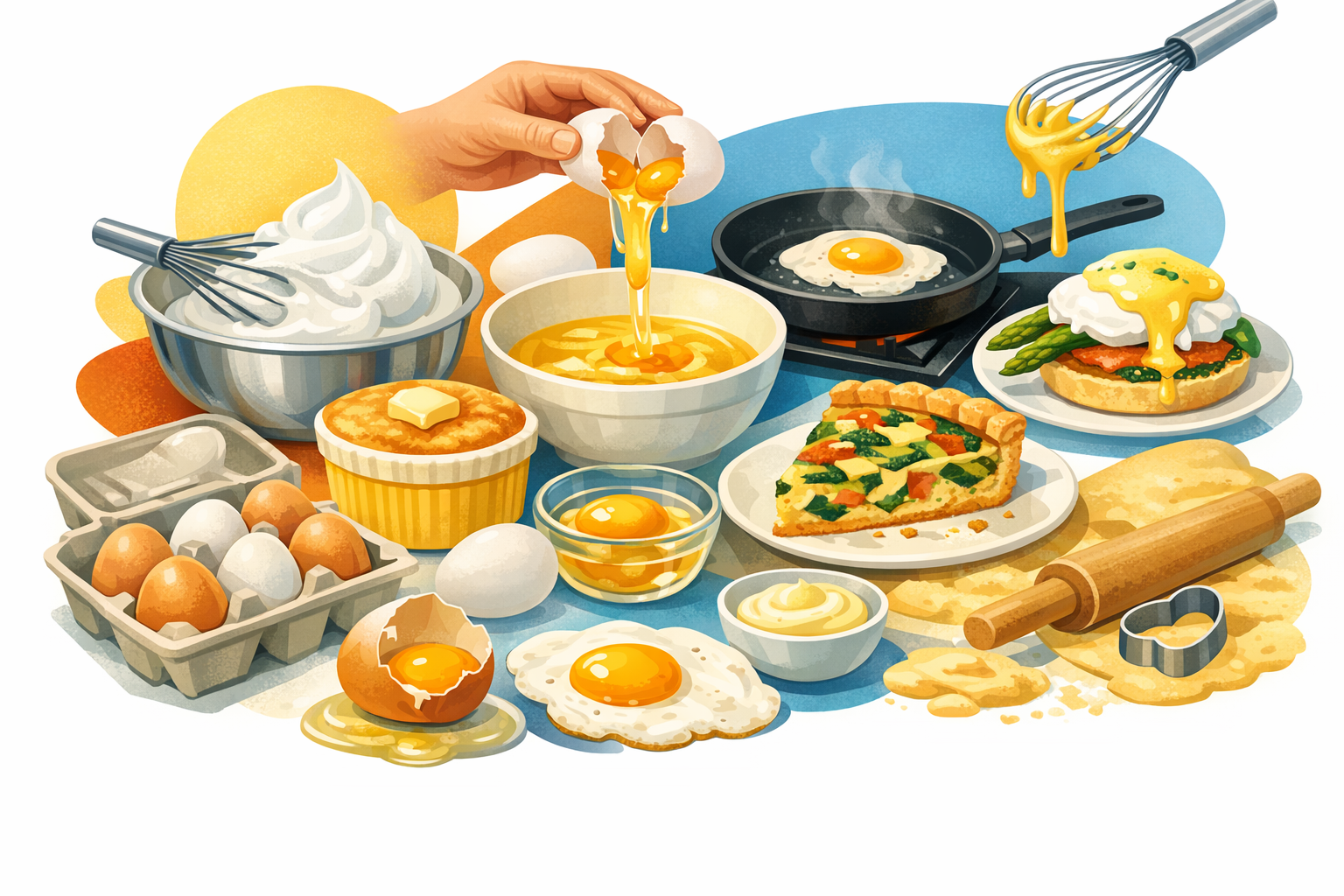
No single ingredient works harder in the kitchen than the egg. It can bind a meatloaf, leaven a soufflé, emulsify a sauce, thicken a custard, clarify a stock, glaze a pastry, and enrich a pasta dough. It is simultaneously a structural material, a foaming agent, a fat source, and a protein delivery system. The fact that most of us keep a dozen of them in the fridge at all times, barely thinking about their versatility, is one of cooking's great ironies.
Understanding how eggs work at a molecular level transforms them from a basic breakfast ingredient into a precision tool. Every role an egg plays in cooking comes down to proteins: how they unfold, how they bond with each other, and how you can control those reactions with heat, acid, sugar, and physical force.
The Anatomy of an Egg
Before we talk about cooking, it helps to know what's actually inside the shell. A large egg weighs about 50 grams total, and those grams are not distributed the way most people assume.
The white (albumen) makes up about 60 percent of the egg's weight. It's roughly 90 percent water and 10 percent protein, with virtually no fat. The primary proteins in egg white include ovalbumin (the most abundant, making up about 54 percent of the total protein), ovotransferrin, and ovomucin. Each of these proteins denatures (unfolds and bonds) at different temperatures, which is why egg whites go through distinct stages as they cook: from translucent and runny, to opaque and soft, to firm and bouncy, to rubbery and tough.
The yolk accounts for about 30 percent of the egg's weight but contains nearly all of the fat (about 5 grams per large egg), most of the calories, and a different set of proteins. The yolk also contains lecithin, a phospholipid that acts as a powerful emulsifier. This single compound is the reason egg yolks can hold together mixtures of fat and water that would otherwise separate immediately.
The remaining 10 percent of the egg's weight is the shell and the thin membranes just inside it.
Eggs as a Binding Agent
When a recipe calls for an egg in meatballs, meatloaf, veggie burgers, or breading, it's using the egg's ability to coagulate. Here's what that means in practice: the proteins in an egg are initially coiled up in tight balls, floating freely in the liquid white or fatty yolk. When you heat them past a certain temperature, those proteins unfold and bond with each other, creating a three-dimensional mesh that traps everything around it.
For egg whites, this coagulation begins around 144°F (62°C) and is complete by about 180°F (82°C). Yolk proteins start coagulating at a slightly higher temperature, around 149°F (65°C), and set fully near 158°F (70°C). When you use a whole beaten egg as a binder, you're creating a protein net that firms up during cooking and literally holds the other ingredients together.
This is why meatballs without egg tend to crumble. It's also why overcooking egg-bound mixtures makes them dense and tight; the protein network keeps contracting as the temperature rises, squeezing out moisture.
Temperature Control Is Everything
The narrow gap between "set" and "overcooked" for egg proteins is just 20 to 30 degrees Fahrenheit. This explains why gentle, low-temperature cooking produces the best results for egg-heavy preparations. A custard cooked slowly in a water bath sets into a silky, trembling texture. The same custard blasted in a hot oven turns grainy and weeps liquid. The proteins are the same; only the temperature management changed.
Eggs as a Leavening Agent
Whipped eggs are one of the oldest leavening methods in baking, predating baking powder by centuries. Angel food cake, soufflés, chiffon cakes, meringues, and génoise all rely on the egg's ability to trap air.
When you whip egg whites, you're doing two things simultaneously. First, you're mechanically forcing air into the liquid, creating tiny bubbles. Second, the whipping action unfolds the proteins, which then migrate to the surface of each air bubble and form a thin, elastic film around it. This is the same principle as soap bubbles, but with protein molecules instead of soap.
The result is a foam that can expand to eight times its original volume. When you heat this foam (in the oven, for instance), the air inside each bubble expands, causing the structure to rise. The surrounding egg proteins then coagulate from the heat, turning the temporary foam into a permanent structure. This is literally how a soufflé works.
Why Soufflés Fall
A soufflé falls because the protein structure isn't strong enough to maintain its expanded shape once it cools and the air contracts. The edges of the soufflé (which cook longer and hotter) remain rigid, but the center (where the proteins set later and less firmly) collapses. A perfectly timed soufflé comes out of the oven with the center just barely set, giving you a narrow window to serve it before physics takes over.
Tips for Better Whipping
Fat is the enemy of foam. Even a trace of yolk in your egg whites will reduce their foaming capacity by up to 50 percent. The fat molecules compete with the proteins for position at the bubble surfaces, destabilizing the foam. This is why recipes emphasize separating eggs carefully and using a clean, dry bowl.
Copper bowls make a difference. The copper ions react with the egg white protein conalbumin to create a more stable foam that's harder to overwhip. If you don't have a copper bowl, a pinch of cream of tartar (tartaric acid) achieves a similar stabilizing effect by lowering the pH.
Sugar stabilizes but slows things down. Adding sugar to whipping egg whites creates a denser, more stable foam (meringue), but it takes significantly longer to reach full volume. The sugar dissolves into the liquid film around each bubble, increasing its viscosity and making it harder for the proteins to unfold. For best results, start whipping without sugar and add it gradually once the whites reach soft peaks.
Room temperature whites whip faster. Cold proteins are tightly coiled and resist unfolding. Whites at room temperature (about 70°F) reach full volume in roughly half the time. However, cold whites are easier to separate cleanly from yolks without breaking, so separate them cold and then let the whites sit out for 15 to 20 minutes before whipping.
Eggs as an Emulsifier
An emulsion is a stable mixture of two liquids that don't normally combine, like oil and water. The classic kitchen example is mayonnaise: a full cup of oil suspended in a tablespoon of lemon juice, held together entirely by egg yolk.
The lecithin in egg yolks is what makes this possible. Lecithin molecules have a water-attracting head and a fat-attracting tail. When you whisk vigorously, the lecithin molecules position themselves at the boundary between each tiny oil droplet and the surrounding water-based liquid, with the fat-loving tails pointed into the oil and the water-loving heads pointed outward. This molecular barrier prevents the oil droplets from merging back together.
Hollandaise sauce, béarnaise sauce, Caesar dressing, and aioli all use this same principle. The yolk's emulsifying power is the reason these sauces have their characteristic creamy, thick consistency rather than separating into pools of oil and acid.
Why Emulsions Break
The most common reason a yolk-based emulsion breaks is adding oil too fast. Each drop of oil needs to be broken into tiny droplets and individually coated by lecithin molecules. If you pour oil in faster than the mechanical action (whisking or blending) can break it up, the droplets are too large to be stabilized and they merge together. This is why every mayonnaise recipe tells you to add oil in a thin, steady stream.
Temperature can also break emulsions. Hollandaise, which is a warm emulsion, will break if the temperature gets too high (above about 160°F). The proteins begin to coagulate, losing their flexibility at the oil-water interface, and the sauce separates into curdled egg and pooled butter.
Eggs as a Thickener
Crème anglaise, lemon curd, pastry cream, carbonara sauce, and avgolemono soup all use eggs to thicken liquids into sauces and creams. The mechanism is the same coagulation described earlier, but controlled at a lower temperature to create a smooth, pourable consistency rather than a firm set.
The key technique is called tempering. If you add cold eggs directly to a hot liquid, the sudden temperature shock coagulates the proteins instantly and you get scrambled egg bits floating in your sauce. Tempering involves gradually raising the egg temperature by whisking small amounts of the hot liquid into the beaten eggs, a few tablespoons at a time, until the egg mixture is warm enough to add back to the pot without curdling.
For custard sauces, the target temperature is usually 170 to 180°F (77 to 82°C). At this range, enough proteins have coagulated to thicken the liquid into a sauce that coats the back of a spoon, but not so many that the texture becomes grainy. A candy thermometer or instant-read thermometer takes the guesswork out entirely.
The Starch Buffer
Pastry cream is more forgiving than crème anglaise because it contains cornstarch or flour. The starch molecules physically interfere with the egg proteins, preventing them from bonding too tightly even at higher temperatures. This is why pastry cream can be brought to a full boil (which would destroy a starch-free custard) without curdling. The starch acts as a buffer that gives you a much wider margin of error.
Eggs and Color
Egg wash (beaten egg brushed onto pastry or bread before baking) serves as both a glue and a browning agent. The proteins in the egg undergo Maillard reactions at oven temperatures, creating a deep golden color and a slight sheen. Different washes produce different results:
Whole egg + water: Standard golden color with a slight sheen. The most common all-purpose wash.
Yolk only + cream: Deep amber color with a high gloss. The extra fat from the yolk and cream creates a richer shine. Used on puff pastry and brioche.
White only: Crisp, clear glaze without much color. Good for sticking toppings (sesame seeds, coarse sugar) to the surface.
The difference between these washes is dramatic. If you've ever wondered why bakery croissants have that impossibly glossy, deep-gold surface while homemade ones look pale and matte, the egg wash is very likely the answer.
Egg Freshness and How It Affects Cooking
Fresh eggs behave differently than older eggs, and both have their advantages.
Poaching and frying: Fresh eggs are better. In a fresh egg, the thick albumen (the viscous layer of white closest to the yolk) is more cohesive and holds its shape. This is why a fresh egg poached in simmering water forms a tight, compact oval, while an older egg spreads out into wispy strands. For fried eggs, fresh eggs give you a taller, more defined shape with less spreading in the pan.
Hard-boiling: Older eggs are better. Fresh eggs are notoriously difficult to peel because the inner membrane clings tightly to the white. As eggs age, the pH of the white rises from about 7.6 to 9.2, which weakens this bond. Eggs that are 7 to 10 days old peel cleanly almost every time. This is one of the few cases where buying eggs a week before you need them is actually the right move.
Whipping: Older whites whip to greater volume (the thinner, more watery white incorporates air more easily), but the foam is less stable. Fresh whites take longer to whip but produce a sturdier foam. For meringues that need to hold their shape, fresh eggs are the better choice.
To test freshness at home, place the egg in a glass of water. Fresh eggs sink and lie flat on the bottom. Eggs that are a week or two old sink but stand upright on one end (the air cell inside has grown). Eggs that float have a very large air cell and should be discarded.
A Few Practical Tips
Always crack eggs on a flat surface, not the rim of a bowl. Cracking on an edge drives shell fragments inward, increasing the chance of shell bits ending up in your food.
Store eggs in their original carton in the body of the fridge, not the door. The door is the warmest part of the fridge and experiences the most temperature fluctuation. Eggs keep for 3 to 5 weeks past the pack date when stored properly.
If a recipe calls for room temperature eggs and yours are cold, place them in a bowl of warm (not hot) tap water for 10 minutes. This brings them up to temperature quickly without any risk of partial cooking.
The next time you crack an egg into a pan, remember that you're working with one of the most sophisticated ingredients in the entire culinary world. Treat it with a little more intention, and it will reward you every time.