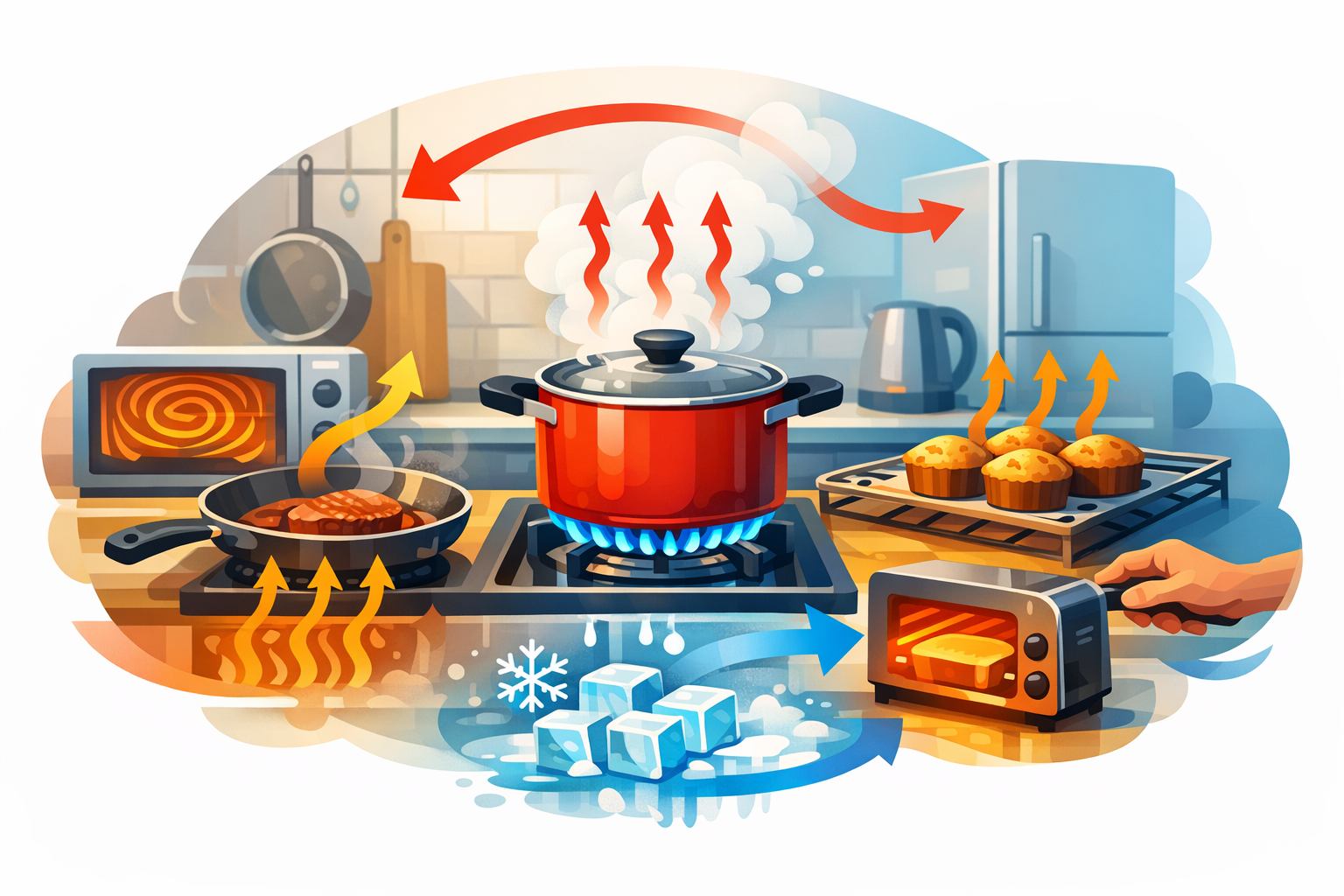
Every cooking technique ever invented is, at its core, a method of transferring thermal energy from a heat source into food. That's it. Grilling, sauteing, baking, boiling, steaming, deep frying, broiling, smoking, sous vide: each one is just a different strategy for getting heat where it needs to go.
The three mechanisms of heat transfer, conduction, convection, and radiation, operate in every kitchen on every burner, in every oven, and on every grill. Most cooking methods rely on two or even all three simultaneously. Understanding how they work, and which one dominates in each technique, gives you a framework for understanding why recipes work the way they do and how to adjust when things go wrong.
Conduction: Heat Through Direct Contact
Conduction is heat transfer between two objects that are physically touching. When you place a steak on a hot cast iron pan, heat flows from the metal surface into the meat through direct molecular contact. The energetic, vibrating molecules in the hot pan bump into the cooler molecules in the steak, transferring energy one molecule at a time.
Conduction is the dominant mechanism in sauteing, searing, pan-frying, and griddle cooking. Any time food sits on a hot surface, conduction is doing the heavy lifting.
Why Pan Material Matters
Different metals conduct heat at dramatically different rates. Copper conducts heat about 25 times faster than stainless steel. Aluminum conducts about 16 times faster. Cast iron conducts only about 3 times faster than stainless steel, but compensates with its enormous thermal mass.
Thermal conductivity tells you how quickly heat moves through the pan. A copper pan distributes heat evenly across its surface almost instantly, eliminating hot spots. A stainless steel pan develops pronounced hot spots directly above the burner, with cooler areas around the edges.
Thermal mass (also called heat capacity) tells you how much energy the pan can store. Cast iron has enormous thermal mass. When you place a cold steak on a cast iron skillet, the pan's temperature barely dips because it has so much stored energy to draw from. A thin stainless steel pan, with much less thermal mass, drops in temperature dramatically when cold food hits it. This temperature drop slows the Maillard reaction and produces steaming rather than searing.
This is the real reason cast iron is prized for searing. It's not that cast iron conducts heat well (it doesn't, compared to copper or aluminum). It's that cast iron stores so much heat that it can deliver a sustained blast of thermal energy to the food's surface without cooling down. For searing, thermal mass matters more than conductivity.
For sauteing, where you're constantly moving food around and want the pan to respond quickly to heat adjustments, conductivity is more important. This is why professional saute pans are often made of copper or aluminum with a thin stainless steel cooking surface. They heat up fast, cool down fast, and respond instantly to changes in burner setting.
Conduction Within Food
Heat doesn't just transfer from pan to food. It also conducts through the food itself, from the hot exterior toward the cooler interior. This internal conduction is slow because food (especially meat) is a poor conductor of heat. Water, which makes up most of the mass of meat and vegetables, conducts heat about 30 times slower than aluminum.
This slow internal conduction is why a thick steak can be charred on the outside and raw in the middle. The surface reaches 400°F or more in seconds, but it takes minutes for that heat to work its way to the center. The steep temperature gradient that results is both a challenge (uneven cooking) and an opportunity (you can create a well-seared exterior while keeping the interior at a precise doneness).
The speed of internal conduction depends primarily on the thickness of the food, not its total mass. A one-inch-thick steak cooks about four times faster than a two-inch-thick steak, because heat has to travel only half the distance but the relationship follows the square law. Doubling the distance quadruples the cooking time. This is why recipes often specify thickness rather than weight.
Convection: Heat Through Fluid Movement
Convection is heat transfer through the movement of fluids (liquids or gases). When you boil pasta, the hot water circulates around the noodles, delivering heat to every surface simultaneously. When you bake bread, hot air circulates around the loaf. In both cases, the moving fluid is the heat delivery vehicle.
Convection is the dominant mechanism in boiling, simmering, steaming, deep frying, and oven baking.
Natural vs. Forced Convection
Natural convection occurs when the fluid moves on its own due to temperature differences. Hot water is less dense than cool water, so it rises. Cooler water sinks to take its place, creating a circular current. The same thing happens with air in an oven: hot air rises from the heating element, cools as it contacts the food and the oven walls, then sinks back down.
Forced convection uses a mechanical device (usually a fan) to move the fluid faster. A convection oven uses a fan to circulate air more aggressively than natural currents would. This forced circulation delivers heat to the food surface faster, which is why convection ovens cook about 25% faster than conventional ovens at the same temperature. It also produces more even cooking because the fan eliminates the stagnant air pockets that cause hot and cold spots.
Deep frying is an example of liquid convection at high temperatures. Oil heated to 350-375°F circulates around the submerged food, cooking it from all sides simultaneously. The high temperature of the oil (compared to boiling water at 212°F) is why fried food cooks so much faster than boiled food. And because oil can reach temperatures well above the Maillard reaction threshold (around 280°F), deep frying produces browning and crust formation that boiling never can.
The Boundary Layer Effect
When a fluid flows over a surface, there's a thin zone right at the surface where the fluid moves very slowly. This is the boundary layer. In cooking, the boundary layer is a thin blanket of cooler air (or liquid) clinging to the food's surface. Heat must conduct through this stagnant layer to reach the food, which slows the overall cooking process.
Stirring, fanning, or using a convection oven fan disrupts the boundary layer, sweeping away the cooled fluid and replacing it with hotter fluid. This is why stirring a pot of soup heats its contents faster, why a convection oven browns more efficiently, and why wind makes cold days feel colder (the wind strips away the warm boundary layer next to your skin).
Steam: Convection's Secret Weapon
Steam is water in its gas phase, and it carries an enormous amount of thermal energy. When steam condenses on food's surface, it releases that energy (called the latent heat of vaporization) directly into the food. This makes steaming significantly more efficient than heating with dry air at the same temperature.
One pound of steam condensing delivers about 970 BTUs of energy to the food. One pound of air cooling by the same temperature delivers only about 0.24 BTUs. That's a roughly 4,000-fold difference, which explains why a 212°F steam burn is far more damaging than briefly touching 212°F air, and why steaming cooks food so effectively.
Professional bread ovens inject steam during the first few minutes of baking. The condensing steam rapidly heats the dough surface, promoting oven spring (the final burst of rising before the crust sets). It also keeps the crust moist and flexible during this critical period, allowing the bread to expand fully before the surface hardens. Once the steam dissipates, dry heat takes over and creates the crispy, deeply browned crust.
Radiation: Heat Without Contact
Radiation is heat transfer through electromagnetic waves. Unlike conduction and convection, radiation doesn't require any physical medium. It travels through empty space at the speed of light. The warmth you feel from a campfire, even when standing ten feet away with no wind, is radiant heat.
Radiation is the dominant mechanism in grilling (from below), broiling (from above), and toasting.
Infrared Radiation in Cooking
All hot objects emit infrared radiation. The hotter the object, the more radiation it emits and the shorter the wavelength. A glowing charcoal fire emits intense infrared radiation, much of which is absorbed directly by the food's surface without heating the air in between.
This is why grilling creates such distinctive results. The intense radiant heat from the coals hits the food surface directly, producing rapid browning and charring. The air between the coals and the food is actually relatively cool compared to the food's surface temperature. This allows you to achieve extreme surface heat (for crust and char) while keeping the interior relatively rare, something that oven baking (which relies on lower-temperature air convection) cannot replicate.
Broiling is grilling in reverse: the radiant heat source is above the food instead of below. Your oven's broiler element heats to around 1,000°F and bathes the food in intense infrared radiation from inches away. This produces rapid browning on the top surface while barely affecting the interior, which is why broiling is useful for finishing dishes, melting cheese, and crisping toppings.
Color and Radiation Absorption
Dark-colored surfaces absorb more radiant energy than light-colored ones. This is why dark baking pans produce darker, crispier bottoms on cookies and bread than shiny aluminum pans. The dark surface absorbs more infrared radiation from the oven's heating element, heats up faster, and conducts more energy to the food.
Shiny surfaces reflect radiation. This is the principle behind a foil tent over a roasting turkey: the foil reflects radiant heat away from the breast, slowing its cooking so the slower-cooking dark meat can catch up.
Putting It All Together: How Techniques Use Multiple Mechanisms
Almost no cooking technique uses just one form of heat transfer. Understanding the blend reveals why each technique produces its characteristic results.
Oven roasting combines all three. The oven walls and heating element emit radiation, which heats the food's surface directly. Hot air circulates through convection, delivering additional heat. And where the food contacts the roasting pan, conduction transfers heat through direct contact. The bottom of a roasted chicken, sitting on a metal rack in a hot pan, cooks through conduction and radiation from the pan surface.
Stir-frying is primarily conduction (food to hot wok surface) but also involves convection (the superheated air above the wok) and radiation (the wok walls above the food line glow with heat in a professional gas wok station). The extreme conductive heat from the wok surface creates the characteristic seared, smoky flavor called wok hei.
Sous vide is pure convection. A precisely heated water bath circulates around vacuum-sealed food, bringing every part of the food to exactly the same temperature. There is no conduction from a hot surface (the food doesn't touch the heating element) and no radiation (the water blocks infrared). This is why sous vide produces such uniformly cooked results, and also why it cannot produce browning or crust (the water temperature is too low for Maillard reactions).
Smoking combines low-temperature convection (warm air and smoke circulating around the meat) with a small amount of radiation from the fire. The low air temperature (225-275°F for most barbecue) means cooking is slow, giving collagen time to convert while smoke compounds deposit on the surface.
Practical Applications of Heat Transfer Knowledge
Once you internalize these principles, you start seeing solutions to cooking problems everywhere.
If the bottom of your pizza is soggy, you have a conduction problem. Your baking surface isn't hot enough or doesn't have enough thermal mass. Preheat a pizza stone for a full hour, or use a steel baking plate, which conducts heat even more efficiently than stone.
If your cookies spread too thin, you have a conduction problem in reverse. Your baking sheet is too hot (possibly from a previous batch), melting the butter before the dough sets. Cool the sheet between batches or use a fresh one.
If your roast is brown on the outside but raw in the center, you have a conduction-rate problem within the food. The exterior is receiving heat faster than it can penetrate to the center. Lower the oven temperature, extend the cooking time, or switch to a reverse sear method that uses low-temperature convection first.
If the top of your casserole browns beautifully while the bottom stays pale, that's the difference between radiation (from the broiler element above) and conduction (from the baking dish below). Move the dish to a lower rack, or place it on a preheated baking sheet to boost bottom-up conduction.
Every cooking problem is, ultimately, a heat transfer problem. And heat transfer follows rules that don't change between recipes, cuisines, or skill levels. Learn the rules once, and they serve you for a lifetime.