Temperature is the invisible hand that controls nearly everything in cooking. It determines whether a steak is juicy or dry, whether bread rises or collapses, whether chicken is safe to eat or dangerous. Yet most home cooks treat temperature casually, cranking burners to high and guessing at doneness by poking food with a finger.
Professional kitchens run on precision. Chefs know that the difference between 130F and 140F in a steak is the difference between medium-rare perfection and a chewy disappointment. They understand that water at 180F poaches gently while water at 212F produces a violent boil that shreds delicate proteins. Temperature is not a detail. It is the mechanism by which raw ingredients become food.
The Maillard Reaction: Where Flavor Is Born
The single most important chemical reaction in cooking occurs between 280F and 330F. Named after French chemist Louis-Camille Maillard, who first described it in 1912, this reaction occurs when amino acids and reducing sugars are exposed to heat. The result is hundreds of new flavor compounds, along with the brown color that signals deliciousness to our brains.
Scientists have identified over 1,000 distinct compounds produced by the Maillard reaction. These include pyrazines (roasty, nutty notes), furanones (caramel-like sweetness), and thiophenes (meaty, savory flavors). The specific compounds produced depend on which amino acids and sugars are present, which is why browned beef tastes different from browned bread, even though both owe their flavor to the same fundamental reaction.
Why 280F Is the Magic Number
Below 280F, the Maillard reaction proceeds so slowly that it produces negligible browning. This is why boiled food never browns; water cannot exceed 212F at sea level. It is also why a pale, steamed chicken breast tastes flat compared to a seared one. The flavor compounds simply never form.
Above 330F, you begin crossing from the Maillard reaction into pyrolysis, or burning. The compounds shift from pleasantly complex to acrid and bitter. A steak with a deeply browned crust was seared in the sweet spot. A steak with a blackened, carbon-crusted exterior was pushed too far.
Caramelization, a related but distinct reaction, occurs when sugars alone are heated above 320F. While the Maillard reaction requires both amino acids and sugars, caramelization is purely sugar-driven. The two reactions often occur simultaneously on food surfaces, which is why roasted onions (high in both natural sugars and amino acids) develop such extraordinary complexity.
Maximizing the Maillard Reaction
Surface moisture is the enemy of browning. Water on the surface of a steak must evaporate before the surface temperature can climb above 212F. This is why patting meat dry before searing is not optional; it is the single most important step. Salting meat and leaving it uncovered in the refrigerator overnight draws out surface moisture and then reabsorbs it into the interior, leaving the surface dry and primed for searing.
High heat and minimal crowding in the pan also matter. When you overload a skillet, the moisture released by the food drops the pan temperature below the Maillard threshold. The food steams instead of sears. Cook in batches if necessary, giving each piece of meat direct contact with scorching-hot metal.
Alkalinity accelerates the Maillard reaction, which is why a pinch of baking soda rubbed onto meat before searing produces faster, deeper browning. Chinese cooking has used this principle for centuries. Velveting, the technique of marinating meat in a mixture that includes baking soda, tenderizes the protein while priming it for rapid browning in a screaming-hot wok.
Protein Denaturation: The Science of Texture
Every protein in food begins in a folded, three-dimensional structure. Heat causes these proteins to unfold, or denature, and then bond with neighboring proteins in new configurations. This process is irreversible and temperature-dependent, which is why cooking transforms the texture of meat, eggs, and fish so dramatically.
Temperature Thresholds in Meat
Myosin, the protein responsible for the "meaty" texture of cooked meat, begins denaturing at 120F and is fully denatured by 140F. When myosin denatures, meat firms up and becomes opaque. This is the transition from raw to cooked that occurs in the 120-140F range.
Actin, the other major muscle protein, denatures between 150F and 160F. When actin denatures, it squeezes moisture out of the muscle fibers like wringing a sponge. This is why a well-done steak (160F+) is dry regardless of how carefully you cook it. The actin has expelled the water, and no amount of resting or basting can put it back.
This explains the target temperatures that experienced cooks use for beef: rare at 120-125F (myosin partially denatured, actin intact, very juicy), medium-rare at 130-135F (myosin fully denatured, actin intact, ideal balance of texture and moisture), medium at 140-145F (actin beginning to denature, moisture starting to leave), and well-done at 160F+ (actin fully denatured, significantly drier).
Fish: A Different Protein Story
Fish proteins denature at lower temperatures than meat proteins because fish have evolved in cold water. Most fish proteins are fully denatured by 140F, which is why fish cooks so much faster than beef or pork. The ideal internal temperature for salmon is 120-125F for translucent, silky flesh or 135-140F for opaque, flaky flesh. Overcooked fish (above 145F) becomes dry and chalky as the proteins contract and squeeze out moisture.
White fish like cod and halibut are particularly unforgiving. Their lean, delicate proteins go from perfect to ruined within a narrow 5-degree window. This is why professional fish cooks rely heavily on instant-read thermometers rather than visual cues.
Eggs: A Precision Instrument
Eggs are extraordinarily sensitive to temperature. The white contains multiple proteins that denature at different temperatures. Ovotransferrin begins setting at 144F, creating a barely gelled, custard-like white. Ovalbumin, the dominant white protein, doesn't fully set until 180F, producing the firm, opaque white most people expect.
The yolk tells a different story. Yolk proteins begin thickening at 149F and become fully set at 158F. This narrow window explains why a perfect soft-boiled egg, with a set white and liquid yolk, requires such precise control. The white needs to reach at least 155F while the yolk stays below 149F. Sous vide cooking achieves this effortlessly; traditional boiling requires careful timing.
Custards exploit this temperature sensitivity beautifully. A creme anglaise (stirred custard sauce) must be cooked to exactly 170-175F. Below that, the egg proteins haven't thickened the sauce sufficiently. Above 180F, the proteins coagulate into scrambled egg curds. The margin for error is roughly 10 degrees.
Collagen Conversion: Turning Tough into Tender
Collagen is the connective tissue protein that makes cheap cuts of meat tough and chewy. It wraps around muscle fibers, binds muscles together, and resists chewing when undercooked. But collagen has a remarkable property: given enough heat and time, it converts to gelatin, transforming tough meat into fork-tender, silky-textured perfection.
The Time-Temperature Relationship
Collagen begins converting to gelatin at around 160F, but the process is slow at that temperature. At 180F, conversion accelerates dramatically. At 200-205F (the temperature of a gentle braise or low oven), collagen dissolves relatively quickly, which is why braised short ribs become tender in 3 to 4 hours.
This is the science behind "low and slow" cooking. A beef chuck roast is loaded with collagen. Cook it to 145F like a steak and it will be inedibly tough. Braise it at 300F until the internal temperature reaches 200-205F and rests there for an hour, and the same cut becomes meltingly tender. The collagen has converted to gelatin, which lubricates the muscle fibers and gives braised meat its characteristic richness.
Why Brisket Stalls at 150F
Barbecue enthusiasts know about "the stall," the frustrating period when a large cut of meat stops rising in temperature for hours. This occurs around 150-170F, precisely when collagen conversion begins in earnest. The conversion process absorbs energy (it is endothermic), and simultaneously, evaporative cooling from surface moisture balances the heat input. The meat's temperature plateaus until enough surface moisture has evaporated and enough collagen has converted. Patience, not higher heat, is the correct response.
Some pitmasters wrap their brisket in foil or butcher paper during the stall (a technique called the "Texas crutch") to reduce evaporative cooling and push through the plateau faster. This works, though it sacrifices some bark formation. Others simply wait it out, understanding that the stall is doing important work inside the meat.
Stock and Bone Broth: Collagen in Liquid Form
The same collagen-to-gelatin conversion that tenderizes braised meat is what gives homemade stock its body. When you simmer bones for 4 to 12 hours, collagen from the joints, tendons, and connective tissue dissolves into the liquid as gelatin. A properly made stock gels when refrigerated, which is the surest sign that enough collagen has been extracted. That gelatin provides the rich, mouth-coating texture that separates homemade stock from the thin, flat taste of store-bought broth.
Starch Gelatinization: Structure from Starch
Starch granules in flour, rice, potatoes, and other carbohydrate-rich foods undergo a transformation called gelatinization when heated in the presence of water. The granules absorb water, swell, and eventually burst, releasing amylose and amylopectin molecules that thicken liquids and create structure.
Temperature Ranges
Wheat starch gelatinizes between 144F and 162F. Corn starch gelatinizes at 144-180F. Potato starch is lower, at 136-150F, which is why potato starch thickens sauces at lower temperatures and produces a clearer result than wheat flour.
This is why you must cook a flour-thickened sauce to at least 180F. Below that temperature, starch granules have not fully gelatinized, and the sauce will thin out as it cools. Above that threshold, the granules have burst completely, and the sauce will hold its viscosity. It is also why adding flour to a sauce and immediately removing it from heat produces a raw, starchy taste. The starch needs sustained heat to fully gelatinize and lose that pasty flavor.
The Role of Starch in Baking
In bread and cake, starch gelatinization is what sets the crumb structure. As the internal temperature of a baking loaf rises above 150F, the starch granules absorb water from the surrounding dough and swell. This absorption firms the crumb and transforms the wet dough into a solid, sliceable structure. If you pull bread from the oven too early (before the center reaches 200-210F), the interior will be gummy because the starch hasn't fully gelatinized.
Carryover Cooking: The Temperature Keeps Climbing
One of the most common cooking mistakes is ignoring carryover. When you remove a piece of meat from the oven or grill, its temperature continues rising for several minutes. The exterior of the meat is significantly hotter than the center, and that thermal energy continues flowing inward even after the heat source is removed.
How Much to Expect
A thin steak might carry over 3-5F. A thick roast can carry over 10-15F. A large turkey might see its breast temperature climb 15-20F after leaving the oven. This means pulling a steak off the grill at your target temperature guarantees overcooking. For a medium-rare finish at 135F, remove the steak at 125-130F and let it rest.
The physics are straightforward. The outer inch of a roast may be at 200F while the center is at 130F. Heat flows from hot to cold. Even without an external heat source, that 70-degree gradient continues driving energy toward the center until the temperature equalizes. The larger the piece of meat and the higher the cooking temperature, the more dramatic the carryover.
Resting Is Not Optional
Resting serves two purposes. First, it allows carryover cooking to distribute heat evenly throughout the meat, eliminating the gradient between the well-done exterior and rare center. Second, it allows the muscle fibers to relax and reabsorb some of the moisture driven to the edges during cooking. A steak cut immediately off the grill will lose significantly more juice than one rested for 5 to 10 minutes. For large roasts, rest 20 to 30 minutes, tented loosely with foil.
Loose tenting is important. Wrapping tightly in foil traps steam, which softens the crust you worked to develop. A loose tent slows heat loss without creating a steamy environment.
Sous Vide vs. High Heat: Precision Meets Power
Sous vide cooking and high-heat searing represent opposite ends of the temperature control spectrum, and the best cooks use both.
The Sous Vide Advantage
Sous vide (French for "under vacuum") involves sealing food in a bag and cooking it in a precisely controlled water bath. The breakthrough insight is that you set the water to your target final temperature. A steak in a 131F bath will eventually reach 131F throughout, edge to edge, and it will never exceed that temperature no matter how long it stays in the water.
This eliminates the gradient problem that plagues traditional cooking. A pan-seared steak has a well-done ring around the outside, a medium zone beneath that, and a medium-rare center. A sous vide steak is the same temperature from edge to edge. The precision is unmatched.
Sous vide also excels at collagen conversion. Cooking a tough cut like short ribs at 155F for 48 hours converts collagen to gelatin while keeping the meat pink and medium-rare throughout. Traditional braising cannot achieve this because the liquid must be at least 180F to convert collagen in a reasonable time, which pushes the meat well past medium.
Why You Still Need High Heat
Sous vide cannot produce the Maillard reaction. A steak cooked at 131F is perfectly tender and uniformly pink, but it has the gray, boiled appearance of cafeteria food. It needs 60 to 90 seconds in a screaming-hot cast iron pan to develop the brown, flavorful crust that makes a great steak. This combination, sous vide for precision followed by a hard sear for flavor, produces results that neither technique can achieve alone.
The Danger Zone: Temperature and Food Safety
Between 40F and 140F, pathogenic bacteria multiply rapidly. At optimal growth temperature (around 90-100F), bacteria like Salmonella and E. coli can double their population every 20 minutes. Leave cooked rice at room temperature for two hours and Bacillus cereus can produce enough toxin to cause illness. Leave a roast chicken on the counter overnight and you are cultivating a bacterial colony.
The FDA estimates that foodborne illness affects roughly 48 million Americans annually, with 128,000 hospitalizations and 3,000 deaths. The majority of these cases trace back to temperature abuse: food held too long in the danger zone, insufficient cooking temperatures, or improper cooling after cooking.
Why Specific Internal Temperatures Matter
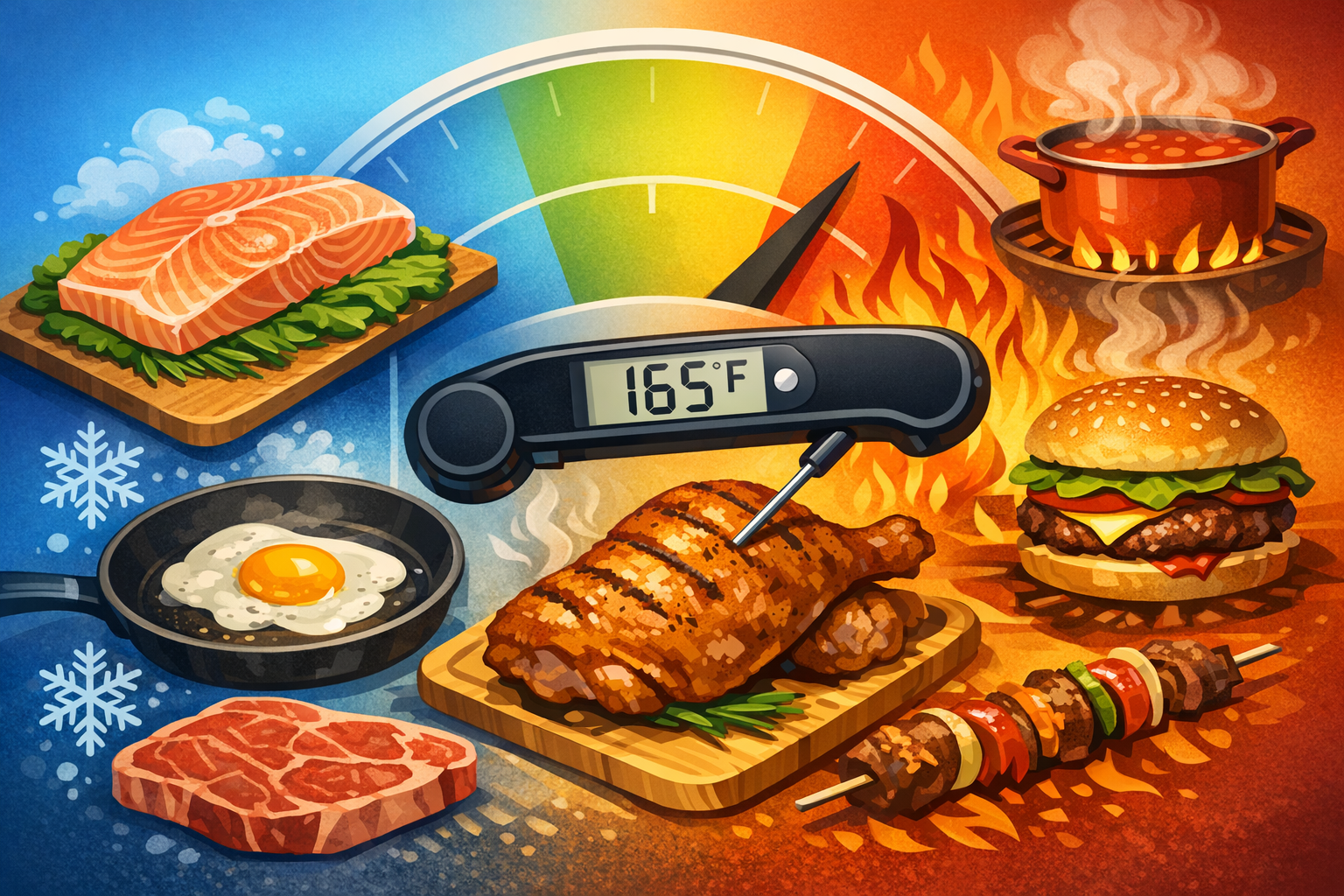
The USDA's recommended internal temperatures are not arbitrary. They represent the point at which enough bacteria have been destroyed to make food safe. Poultry reaches safety at 165F because Salmonella is killed instantly at that temperature. But here is the nuance most guidelines omit: Salmonella is also killed at 150F if held for 3 minutes, or at 145F if held for 8 minutes. Pasteurization is a function of both time and temperature.
This is why sous vide chicken cooked to 150F for an extended period is perfectly safe, even though it falls below the USDA's instant-kill threshold. The sustained heat achieves the same bacterial reduction through longer exposure. Understanding this principle opens up new textures and possibilities, like chicken breast that is juicy and tender rather than dry and chalky.
Pork tells a similar story. The USDA revised its pork guidelines in 2011, dropping the recommended temperature from 160F to 145F with a 3-minute rest. The old 160F recommendation was rooted in fears of Trichinella parasites, but modern pork production has virtually eliminated that risk. Pork cooked to 145F is slightly pink, significantly juicier, and just as safe as the overcooked, gray pork of previous generations.
Ground Meat Is Different
Whole muscle cuts like steaks carry bacteria primarily on their surface. A quick sear kills surface pathogens, which is why a rare steak is safe. Ground meat is different. The grinding process distributes surface bacteria throughout the interior. A burger must reach 160F throughout because bacteria are present at the center, not just the outside. Grinding your own meat from whole cuts at home somewhat reduces this risk, but the safe practice remains: ground meat gets cooked through.
Cooling: The Overlooked Danger
Food safety does not end when cooking finishes. Hot food must pass through the danger zone quickly during cooling to prevent bacterial regrowth. The FDA recommends cooling food from 140F to 70F within 2 hours, then from 70F to 40F within an additional 4 hours. Large pots of soup or stock are the biggest offenders. A gallon of hot stock placed directly in the refrigerator can take 12 hours to cool to a safe temperature at its center, spending far too long in the danger zone. Dividing hot foods into shallow containers, using ice baths, or stirring with frozen water bottles all accelerate cooling to safe speeds.
Building Temperature Intuition
The goal is not to cook with a thermometer permanently embedded in every piece of food, though a good instant-read thermometer is the single most valuable kitchen tool you can own. Serious cooks recommend the Thermapen or similar instant-read models that deliver readings in 2 to 3 seconds. A $15 investment in accuracy pays back every time you cook a piece of protein.
The deeper goal is to understand why temperature matters so you can make informed decisions. When you know that collagen converts to gelatin above 160F, you understand why a braise needs hours at low heat. When you know actin denatures above 150F, you understand why overcooking a steak by ten degrees makes such a dramatic difference. When you know the Maillard reaction requires 280F, you understand why a dry surface and a hot pan are non-negotiable for browning.
Temperature is the language your food speaks. Learning to listen to it, and to control it, is what separates competent cooking from truly great cooking.