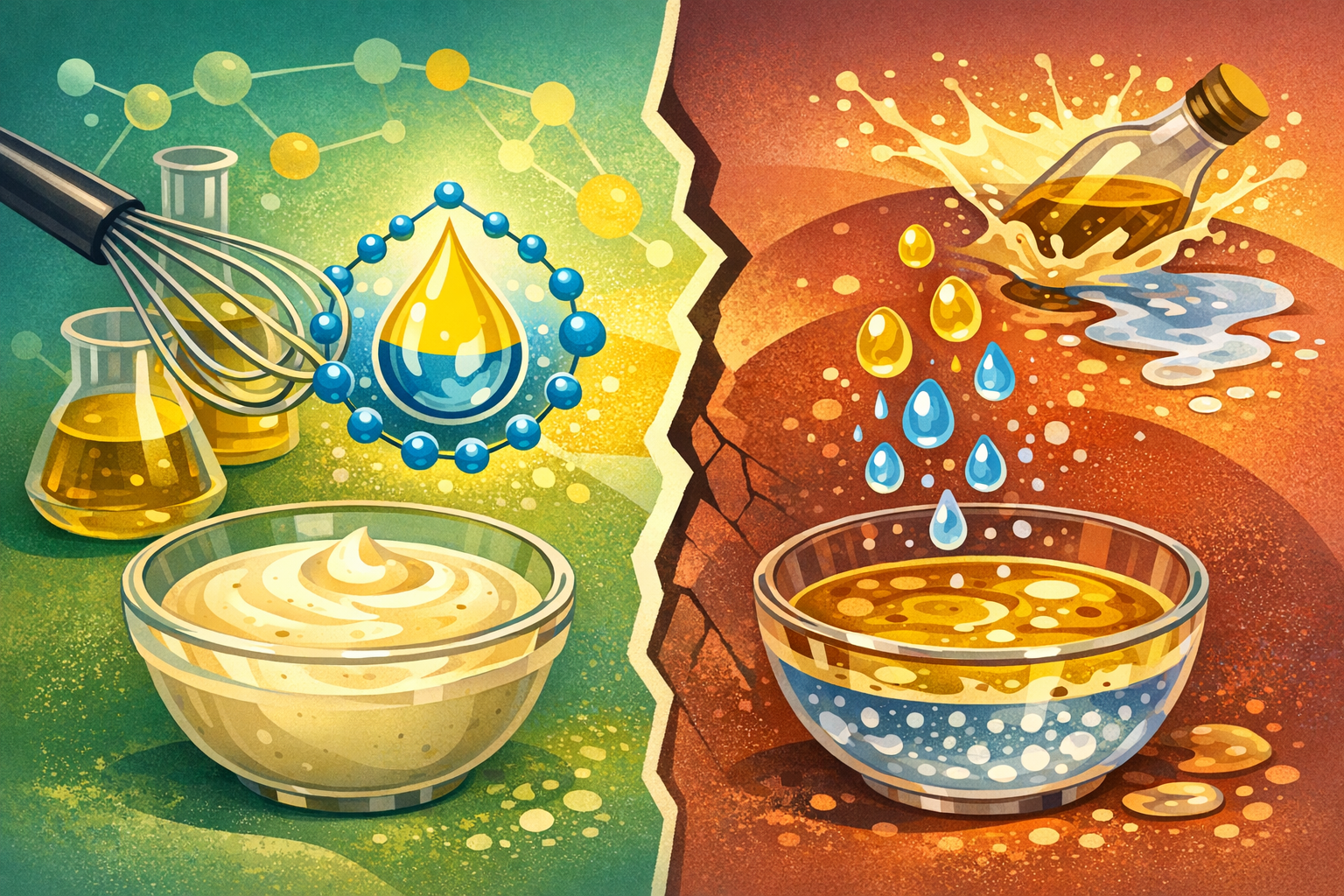
Oil and water don't mix. Everyone knows this. But some of the most essential preparations in cooking, from vinaigrettes and mayonnaise to hollandaise and cream sauces, require exactly that: oil and water, blended into a smooth, stable, unified sauce. The process of forcing these reluctant partners together is called emulsification, and understanding the science behind it will solve most of the sauce problems you've ever encountered.
A broken hollandaise, a vinaigrette that separates in minutes, a mayonnaise that refuses to thicken: these aren't random failures. They're predictable outcomes of specific physical conditions, and every one of them can be prevented or fixed once you understand the underlying mechanics.
What an Emulsion Actually Is
An emulsion is a stable mixture of two liquids that normally wouldn't combine. In cooking, this almost always means water-based liquids (vinegar, lemon juice, stock, wine) and fat (oil, melted butter). The two substances don't dissolve into each other. Instead, one is dispersed as tiny droplets suspended within the other.
The type of emulsion depends on which substance forms the droplets and which forms the surrounding continuous phase.
In an oil-in-water emulsion, tiny oil droplets are suspended in a water-based liquid. Mayonnaise, hollandaise, milk, and most cream sauces are oil-in-water emulsions. The sauce feels water-based on your palate even though it may contain more fat than water by volume.
In a water-in-oil emulsion, tiny water droplets are suspended in fat. Butter and margarine are water-in-oil emulsions. They feel fatty on the tongue because fat is the continuous phase that contacts your palate.
The size of the dispersed droplets determines the emulsion's appearance and texture. Large droplets scatter light differently than small ones, which is why a coarse vinaigrette looks cloudy while a properly made mayonnaise is opaque and glossy. Smaller droplets also produce a thicker, more stable sauce because they pack together more tightly and have more surface area for emulsifiers to work on.
Why Oil and Water Separate
To understand emulsification, you need to understand why oil and water resist mixing in the first place.
Water molecules are polar: they have a slight positive charge on one end and a slight negative charge on the other. This polarity makes water molecules strongly attracted to each other through hydrogen bonds. Oil molecules are nonpolar, with no charge separation. They interact through weaker Van der Waals forces.
When you try to combine the two, the water molecules prefer bonding with other water molecules, and the oil molecules prefer associating with other oil molecules. The system naturally minimizes the contact area between the two phases by separating into distinct layers, with the less dense oil floating on top.
Forcing oil into tiny droplets within water creates an enormous amount of oil-water interface. This interface is thermodynamically unstable; the system "wants" to reduce it by merging the small droplets back into larger ones and eventually into a single oil layer. This tendency is why unsupported emulsions break so quickly. A simple vinaigrette of oil and vinegar, shaken vigorously, begins separating within minutes.
Emulsifiers: The Molecular Peacemakers
Emulsifiers are molecules that have both a water-loving (hydrophilic) end and an oil-loving (lipophilic) end. They position themselves at the oil-water interface with their hydrophilic end pointing into the water phase and their lipophilic end extending into the oil droplet. This creates a protective coating around each droplet that prevents it from merging with its neighbors.
The kitchen is full of natural emulsifiers.
Lecithin, found abundantly in egg yolks, is the most powerful culinary emulsifier. A single egg yolk contains enough lecithin to emulsify several cups of oil, which is why mayonnaise can hold such an extraordinary amount of fat in suspension. Lecithin is also present in soy (soy lecithin is a common food additive) and in mustard seeds.
Mustard contains both mucilage (a natural thickener) and compounds that act as emulsifiers. This is why a teaspoon of Dijon mustard in a vinaigrette dramatically improves its stability. The mustard particles position themselves at the oil-water interface and physically block droplets from coalescing.
Casein and whey proteins in dairy products are effective emulsifiers. This is why cream-based sauces are naturally more stable than oil-and-water sauces. The milk proteins coat the fat droplets and keep them in suspension.
Gelatin from meat stocks provides excellent emulsification. A pan sauce made with homemade stock (rich in dissolved gelatin) will be naturally glossy and cohesive. The same sauce made with commercial broth (which typically contains little to no gelatin) will be thin and prone to separating.
How Much Emulsifier Do You Need?
More emulsifier means more stable emulsions, but there are practical limits. In mayonnaise, one egg yolk can emulsify about one cup (240ml) of oil. Push past that ratio and the emulsion becomes increasingly fragile. For vinaigrettes, one teaspoon of Dijon mustard per quarter cup of vinegar provides a good baseline.
The relationship isn't linear. Doubling the emulsifier doesn't double the stability. Instead, there's a threshold below which the emulsion is fragile and above which it's reasonably robust. Most recipes are calibrated to sit comfortably above this threshold.
Making Mayonnaise: Emulsion Principles in Practice
Mayonnaise is the purest expression of emulsion science in the kitchen. It contains roughly 80% oil by weight, yet it's a thick, creamy, scoopable substance rather than an oily liquid. Understanding how it works illuminates the principles behind every other emulsion.
The process starts with egg yolks, which contain lecithin and water. You whisk in acid (lemon juice or vinegar), which thins the yolks slightly and provides the water phase. Then you add oil, slowly.
The critical word is "slowly." In the initial stages, you're adding oil drops into a relatively large amount of water-phase liquid. Each drop gets immediately surrounded by emulsifier molecules and broken into tiny sub-droplets by the whisking action. As you add more oil, the ratio shifts: there's less and less water phase and more and more oil phase. The droplets pack together more tightly, which is what makes the mayonnaise thicken.
If you add oil too quickly at the beginning, you overwhelm the available emulsifier. Large oil drops form that can't be adequately coated, and they merge together. The result is a broken mayonnaise: a thin, curdled-looking liquid where oil and water have visibly separated.
The fix is simple. Start with a new egg yolk in a clean bowl. Whisk the broken mayonnaise into the new yolk, one teaspoon at a time, treating the broken mayo as if it were the oil. The fresh lecithin from the new yolk re-emulsifies the mixture, and you can continue adding oil normally once the sauce comes back together.
Temperature Matters
All ingredients for mayonnaise should be at room temperature. Cold egg yolks are more viscous and don't release their lecithin as readily. Cold oil is thicker and harder to break into small droplets. The ideal working temperature is around 65-70°F.
Conversely, very warm temperatures (above 80°F) can destabilize mayonnaise because the increased molecular energy makes it easier for droplets to overcome the emulsifier barrier and merge. This is why mayo left in the sun at a picnic eventually thins and separates.
Vinaigrettes: Temporary vs. Stable
A classic French vinaigrette (three parts oil to one part vinegar, whisked together) is a temporary emulsion. It will separate within minutes because the only thing keeping the oil droplets dispersed is the mechanical energy you put in by whisking. There's no emulsifier to maintain the suspension once you stop.
This isn't necessarily a problem. Many cooks prefer to shake or whisk their vinaigrette immediately before dressing a salad. The temporary emulsion coats the leaves evenly and then separates back in the bottle for next time.
But if you want a vinaigrette that stays emulsified for hours or days, you need emulsifiers and technique.
Start with the acid (vinegar or citrus juice), salt, and your emulsifier (Dijon mustard is standard; a small amount of honey also helps by increasing the viscosity of the water phase). Whisk these together thoroughly. Then add the oil in a slow, steady stream while whisking constantly, exactly like making mayonnaise. The mustard and the mechanical action of whisking create small, coated oil droplets that resist merging.
A blender or immersion blender produces even more stable vinaigrettes because the high-speed blade creates much smaller droplets than hand whisking. Smaller droplets are inherently more stable because they have a higher surface-area-to-volume ratio, meaning more of each droplet's surface is covered by emulsifier.
Another trick: add a small piece of roasted garlic or a tablespoon of tahini. Both contain natural emulsifiers and thickeners that improve stability significantly.
Hot Emulsions: Hollandaise, Beurre Blanc, and Pan Sauces
Hot emulsions follow the same principles as cold ones but add the complication of heat, which can both help and hinder the process.
Hollandaise
Hollandaise is essentially a warm mayonnaise made with butter instead of oil. Egg yolks provide the emulsifier, lemon juice provides the acid, and clarified butter provides the fat. The warmth serves a specific purpose: it keeps the butter liquid. Butter solidifies below about 90°F, so hollandaise must be kept warm enough to stay fluid but cool enough that the egg yolks don't scramble.
The danger zone is narrow. Below 145°F, the sauce is safe but may thicken sluggishly. Above 160°F, the egg proteins begin to coagulate, curdling the sauce into scrambled-egg particles floating in liquid butter. The ideal holding temperature is 145-155°F.
If hollandaise breaks from overheating, add a tablespoon of cold water and whisk vigorously. The cold water drops the temperature below the coagulation point and provides additional water phase for re-emulsification. If that doesn't work, start with a fresh yolk (as with broken mayonnaise) and whisk the broken sauce in gradually.
Beurre Blanc
Beurre blanc (white butter sauce) is a hot emulsion that uses no egg. Instead, a reduction of wine, vinegar, and shallots provides the water phase, and cold butter whisked in gradually provides both the fat and the emulsifier (remember, butter itself is an emulsion containing milk proteins that act as emulsifiers).
The technique is simple but demands attention. Reduce the wine-vinegar-shallot mixture to about two tablespoons of liquid. Lower the heat to very low. Add cold butter one tablespoon at a time, whisking constantly. Each piece of butter must be mostly incorporated before the next is added.
The cold butter is critical. It melts slowly, releasing its butterfat gradually into the reduction while simultaneously cooling the pan slightly. If the pan gets too hot, the butter melts too fast, overwhelming the emulsifying capacity of the milk proteins, and the sauce breaks into an oily puddle. If the pan cools too much, the butter doesn't melt and you get chunks floating in liquid.
Once made, beurre blanc cannot be reheated above about 160°F without breaking. Hold it in a warm spot (a turned-off oven, a double boiler over warm water) and use it within 30 minutes.
Pan Sauces
The pan sauce you make after searing a steak or chicken breast is an emulsion, even if you've never thought of it that way. The fond (browned bits on the pan) dissolves into wine or stock, providing the water phase. Any fat remaining in the pan provides the oil phase. And the gelatin in the stock (if you're using good stock) acts as the emulsifier.
This is why pan sauces made with homemade stock are glossy and cohesive, while those made with water or thin commercial broth are watery and greasy. The gelatin makes all the difference.
If you're working with commercial broth, you can compensate by finishing the sauce with a tablespoon of cold butter (the monte au beurre technique). The cold butter melts slowly into the sauce, and its milk proteins emulsify the fat into the liquid, creating a richer, more unified result.
Why Emulsions Break and How to Prevent It
Emulsions fail for a small number of predictable reasons.
Too much fat added too fast. This is the most common cause. Always start slowly, especially when the emulsion is young and there's plenty of water phase available. Once the emulsion is established and thick, you can add fat more quickly.
Temperature shock. Sudden temperature changes destabilize the emulsifier layer around droplets. Let ingredients come to compatible temperatures before combining them. Don't pour ice-cold cream into a simmering sauce without tempering it first.
Excessive heat. Protein-based emulsifiers (egg, dairy) denature and lose their emulsifying ability at high temperatures. Keep hollandaise below 160°F. Keep beurre blanc below 160°F. Never boil a cream sauce vigorously (gentle simmering is fine).
Insufficient emulsifier. If your vinaigrette always breaks, add more mustard. If your mayonnaise is too thin, you probably need another egg yolk. Ratios matter.
Mechanical disruption. Aggressively stirring or blending a finished emulsion can actually break it by shearing apart the emulsifier layer. Stir gently to incorporate, don't beat aggressively once the sauce has come together.
Understanding emulsions is understanding sauces. And understanding sauces is, for many cooks, the difference between food that's merely good and food that's truly memorable.