Every time you sear a steak, toast bread, or roast coffee beans, you witness one of the most important chemical reactions in cooking. The Maillard reaction, named after French chemist Louis-Camille Maillard, who first described it in 1912, is responsible for the complex, savory, deeply satisfying flavors that make cooked food taste fundamentally different from raw ingredients.
Yet most home cooks misunderstand how browning actually works. Many confuse it with caramelization, a completely different process. Others still believe the myth about "sealing in juices" that was debunked over a century ago. Understanding the real science behind browning gives you precise control over flavor development, and once you grasp these principles, you'll approach your stovetop, oven, and grill with an entirely different mindset.
This guide breaks down the chemistry of the Maillard reaction in practical terms, explains why temperature and moisture are the two variables that matter most, and shows you how to apply this knowledge to produce better results with everything from scrambled eggs to roasted vegetables.
What Actually Happens When Food Browns
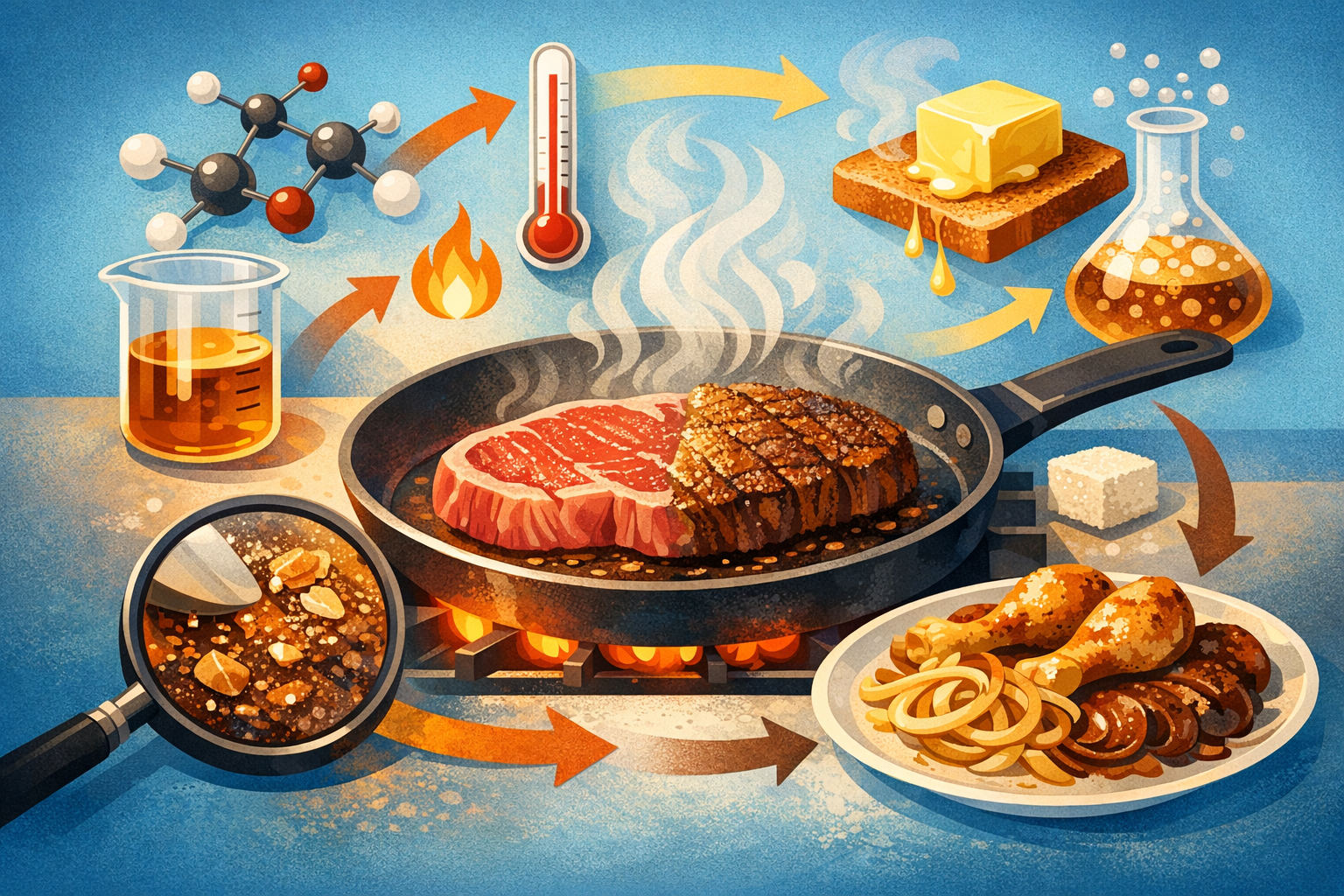
The Maillard reaction isn't a single reaction. It's a cascade of hundreds of chemical reactions that occur when amino acids (the building blocks of proteins) interact with reducing sugars (like glucose and fructose) at temperatures above 280°F (140°C). The result is a staggering array of new flavor compounds, aromatic molecules, and brown pigments called melanoidins.
Here's the simplified version of what happens at the molecular level. First, an amino acid and a sugar molecule combine to form what chemists call an Amadori compound. An unstable intermediate. This compound then breaks down along multiple pathways simultaneously, producing hundreds of different molecules. Some of these are volatile aromatics. The smell of bread baking, coffee roasting, or steak searing. Others are non-volatile flavor compounds that register on your tongue as savory, bitter, sweet, or nutty. Still others are the brown-colored melanoidins that give seared meat its crust and toasted bread its golden surface.
What makes the Maillard reaction so powerful is its sheer complexity. A single piece of bread contains dozens of different amino acids and sugars, and each amino acid–sugar pairing produces a different set of flavor compounds. Cysteine paired with ribose creates meaty, savory notes. Proline and glucose produce bread-like aromas. Leucine and glucose generate malty, chocolate-like flavors. This is why browning creates such layered, nuanced taste. Your palate is detecting hundreds of distinct molecules simultaneously.
How This Differs From Caramelization
These two processes get confused constantly, but they are chemically distinct. Caramelization involves only sugars. No proteins needed. It occurs at higher temperatures (above 320°F/160°C for most sugars) and produces a different, generally simpler set of flavors: butterscotch, toffee, and the characteristic sweetness of caramel.
The Maillard reaction requires both sugars and amino acids, starts at lower temperatures, and creates far more complex flavors. Savory, roasted, nutty, and meaty notes that caramelization alone cannot produce.
In practice, both reactions often happen simultaneously. When you roast an onion, the natural sugars caramelize while the amino acids undergo Maillard reactions with those same sugars. The combined result is more complex than either reaction alone could produce, which is one reason deeply roasted onions have such extraordinary depth of flavor.
Temperature and Moisture: The Two Variables That Control Everything
Understanding two principles will transform your cooking more than any recipe ever could.
The 280°F Threshold
The Maillard reaction begins around 280°F (140°C) and accelerates dramatically as temperature rises, up to about 355°F (180°C). Above that point, you start getting excessive charring and bitter compounds from pyrolysis. Actual burning. The window between 280°F and 355°F is where controlled, flavorful browning happens.
Here's the critical problem: water boils at 212°F (100°C). As long as there is surface moisture on your food, evaporating water holds the surface temperature at 212°F. Well below the Maillard threshold. Wet food cannot brown. The surface must dry out completely before it can reach the temperatures needed for the Maillard reaction to begin.
This single fact explains cooking rules that seem arbitrary until you understand the underlying chemistry.
Why you should pat steaks dry before searing. Every drop of surface moisture must evaporate before browning can start. A wet steak wastes valuable pan time boiling off water instead of building a crust. Experiments by food scientist Harold McGee showed that thoroughly dried steaks brown up to 50% faster than wet ones cooked in an identical pan at the same temperature.
Why crowding the pan ruins your sear. When too many pieces of food are packed together, the moisture they release gets trapped as steam between them. The temperature at the food's surface drops below 212°F, and instead of searing, you are steaming. Leave at least an inch between pieces, or cook in batches. Your patience will be rewarded with a dramatically better crust.
Why high heat isn't always the answer. A screaming-hot pan can burn the outside of thick cuts before the interior cooks. For proteins thicker than an inch, moderate heat gives moisture time to evaporate from the surface while the interior gradually comes up to temperature. Many restaurant kitchens start thick steaks in a low oven (around 250°F) to dry the surface completely, then finish with a hard sear in cast iron. A technique called the reverse sear.
The pH Shortcut Most Cooks Don't Know
Alkaline environments dramatically accelerate the Maillard reaction. Raising the pH of a food's surface speeds up browning at any given temperature.
This is why traditional pretzel recipes call for dipping dough in a lye (sodium hydroxide) solution before baking. The alkaline surface browns faster and more deeply, producing that characteristic dark, glossy pretzel crust. You can achieve a similar, safer effect with ordinary baking soda.
Chinese velveting techniques sometimes add a small pinch of baking soda to meat marinades. Not primarily for tenderizing, as commonly believed, but because the alkaline environment promotes faster, more even browning when the meat hits the wok.
Try this experiment at home: toss one batch of sliced onions with a quarter teaspoon of baking soda before sautéing, and cook another batch without it. The baking soda batch will brown in roughly half the time and develop a deeper, more complex flavor. The trade-off is a slightly softer texture, since alkaline conditions also break down pectin in the vegetable cell walls.
Practical Applications Across Your Kitchen
Once you internalize the moisture-temperature relationship, you can troubleshoot almost any browning problem and improve dishes you have been making for years.
Roasted Vegetables That Actually Caramelize
The most common mistake with roasted vegetables is using too low a temperature and too crowded a sheet pan. Vegetables are mostly water, zucchini is 95% water, broccoli is 89%, and even potatoes are about 80%, so they need aggressive heat to drive off surface moisture fast enough for browning to begin.
Set your oven to at least 425°F (220°C). Spread vegetables in a single layer with visible space between each piece. Toss them with just enough oil to lightly coat each surface. Oil conducts heat more efficiently than air, which speeds up the drying of the outer layer. Resist the urge to toss or stir for the first 15 to 20 minutes. You want the bottom surface to stay in direct contact with the hot sheet pan long enough to dry out and develop deep browning. Stirring too early reintroduces moisture from the interior and resets the browning process.
For even better results, salt your cut vegetables 20 to 30 minutes before roasting and then blot them dry with paper towels. Salt draws out cellular moisture through osmosis. Removing that extra liquid before the vegetables hit the oven means they spend less oven time steaming and more time actively browning. The difference between salted-and-blotted roasted broccoli and broccoli that goes straight from cutting board to oven is striking.
Building the Perfect Sear on Proteins
Whether you are cooking a ribeye, pork chop, chicken thigh, or piece of salmon, the fundamental approach is identical.
Dry the surface thoroughly with paper towels. Both sides, pressing firmly. Season generously with salt, which draws out a thin layer of surface moisture that quickly evaporates in a hot pan. Preheat your skillet until a single drop of water flicked onto the surface evaporates within one second. Add a thin film of high-smoke-point oil. Avocado oil (smoke point around 520°F) or refined grapeseed oil (about 420°F) both work well. Place the protein in the pan and do not move it. The fond, those browned bits that form on the pan surface around the meat, represents concentrated Maillard flavor. Leave it there during cooking, then deglaze the pan afterward with wine, stock, or even just water to dissolve that fond into a quick pan sauce.
For thicker cuts over 1.5 inches, the reverse sear produces the best combination of crust quality and internal doneness. Start on a wire rack set over a sheet pan in a 250°F oven until the internal temperature reaches about 10 to 15 degrees below your target. Then transfer to a preheated cast iron or carbon steel pan and sear for 45 to 60 seconds per side. Because the low oven time thoroughly dried the surface, the Maillard reaction kicks in almost the instant the meat contacts the hot metal. The result is a thicker, more uniform, more deeply flavored crust than you can achieve by searing first.
Bread, Pastry, and Baked Goods
Commercial bakeries routinely manipulate the Maillard reaction through techniques that home bakers can easily adopt.
Steam in the first minutes of baking keeps the crust surface moist and flexible, allowing maximum oven spring. That rapid burst of rising that happens when dough first enters a hot oven. Once the steam dissipates, the crust dries out and browning begins. You can replicate commercial steam injection by placing a handful of ice cubes in a preheated cast iron pan on the oven floor, or by baking bread in a preheated Dutch oven with the lid on for the first 20 minutes.
Egg washes accelerate browning because eggs contain both proteins and sugars. Exactly what the Maillard reaction requires. A whole-egg wash produces a deep golden crust. Egg yolk alone gives even richer color. Milk washes work through the same principle, since milk contains lactose (a reducing sugar) and casein (a protein).
Sugar content in dough directly affects crust color. Enriched doughs with more sugar, like brioche or challah, brown faster and darker than lean doughs like baguettes or ciabatta. This is why enriched breads typically bake at 350°F instead of the 450°F used for lean breads. The lower temperature prevents the sugar-rich surface from over-browning before the interior bakes through.
Advanced Browning Techniques Worth Trying
Dry Brining for a Superior Crust
Dry brining, salting meat heavily and refrigerating it uncovered for 12 to 48 hours, accomplishes two things at once. The salt gradually penetrates deep into the muscle fibers, seasoning the meat throughout rather than just on the surface. Simultaneously, the dry, circulating refrigerator air slowly dehydrates the exterior. After dry brining, a steak's surface feels noticeably drier and slightly tacky to the touch. That dehydrated surface means nearly instant browning when it contacts a hot pan.
Kenji López-Alt's extensive testing at Serious Eats demonstrated that dry-brined steaks developed a measurably thicker, more flavorful crust in the same total cooking time compared to steaks that were simply seasoned moments before cooking. The technique works beautifully on pork chops, chicken (especially skin-on pieces), and even duck breasts.
Milk Powder as a Browning Amplifier
Nonfat milk powder is packed with both lactose (a reducing sugar) and casein (a protein). Essentially concentrated Maillard reaction fuel in powdered form. Adding a tablespoon or two of milk powder to burger blends, cookie doughs, or dry rubs for roasted meat amplifies browning and introduces a savory, almost umami-like depth that's difficult to achieve otherwise.
Chef Christina Tosi of Milk Bar popularized this technique in baking, using milk powder extensively in her cookie and cake recipes. But the principle translates directly to savory cooking. Mix milk powder into your meatball or meatloaf blend, stir it into a dry rub for ribs, or add it to the flour dredge for fried chicken. The added lactose and protein give the Maillard reaction more raw material to work with, and the results are visible in the deeper, more complex browning you get.
Why Dry-Aged Beef Browns Differently
If you have ever seared a dry-aged steak and noticed it browns faster and tastes dramatically more complex than fresh beef, the Maillard reaction explains why. During the aging process, which typically runs 28 to 45 days in a controlled humidity and temperature environment, natural enzymes in the meat slowly break down large protein molecules into free amino acids. Simultaneously, the controlled airflow dehydrates the surface, concentrating those free amino acids.
When a dry-aged steak finally hits the pan, two things work in its favor: there is significantly less surface moisture to boil off, and there is a much higher concentration of free amino acids available to react with sugars. The Maillard reaction ignites faster and produces a wider array of flavor compounds. This is a major part of what people mean when they describe the "funky" or "nutty" depth of well-aged beef.
Browning Myths That Refuse to Die
"Searing seals in juices." This is the most persistent myth in all of cooking. German chemist Justus von Liebig proposed this theory in 1850, and it was debunked experimentally as early as the 1930s. Carefully controlled tests consistently show that seared meat actually loses slightly more moisture by weight than gently cooked meat, because the intense heat drives off water faster. You sear for flavor, those Maillard compounds, not for moisture retention.
"You need expensive cookware to get a good sear." A $30 cast iron skillet from Lodge produces a sear functionally identical to a $300 copper-core pan. The property that matters is thermal mass. The pan's ability to hold onto its heat when cold food is placed on its surface. Cast iron and carbon steel have excellent thermal mass relative to their cost. Thin stainless steel pans lose temperature rapidly when food hits them, which stalls browning. Weight matters more than price.
"Extra virgin olive oil cannot be used for searing." Extra virgin olive oil has a smoke point around 375°F, which is comfortably above the Maillard reaction threshold. It works perfectly well for searing at moderate temperatures, and it adds its own flavor complexity. For extremely high-heat searing where you want the pan well above 400°F, avocado oil or refined safflower oil are better choices, but do not write off olive oil for everyday browning tasks.
Putting It All Together
The Maillard reaction comes down to managing two variables: getting the surface temperature above 280°F, and removing surface moisture so that temperature threshold can actually be reached. Every browning technique in cooking, patting food dry, preheating pans aggressively, using high oven temperatures, dry brining overnight, dusting with baking soda, is a strategy for achieving one or both of those goals.
Once you see your kitchen through this lens, cooking decisions become far more intuitive. When something refuses to brown, ask yourself two questions: is there too much surface moisture, or is the heat source not hot enough? When something browns too fast and threatens to burn, the solution is the inverse. Reduce the heat or introduce moisture. A splash of water in the pan, a lid to trap steam, a lower oven temperature. These are not arbitrary adjustments or guesswork. They are logical, predictable consequences of the same basic chemistry.
A steak that spent two days uncovered in the fridge needs less searing time than one straight from the package. Vegetables on a humid summer day may need an extra five minutes of roasting. Bread dough enriched with honey needs a lower oven temperature than a lean sourdough. Once you understand the mechanism, the adjustments become obvious.
Master the Maillard reaction, and you have mastered the single most important flavor-development tool available in any kitchen.