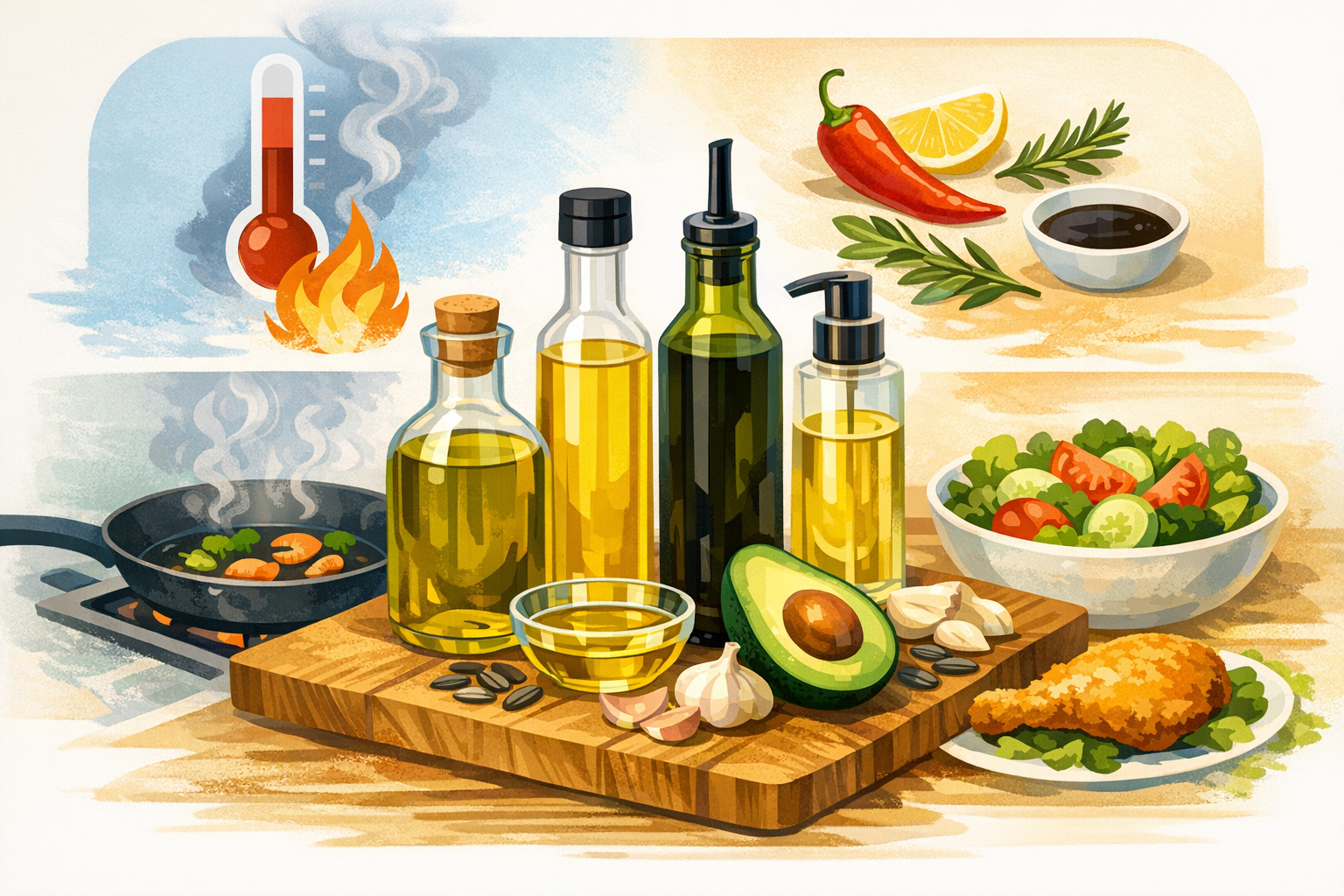
Walk into any well-stocked grocery store and you'll find an entire aisle dedicated to cooking oils. Extra virgin olive oil, avocado oil, coconut oil, grapeseed oil, sesame oil, walnut oil, peanut oil, and a dozen more. Each bottle makes its own health claims and flavor promises, and most home cooks end up buying one or two familiar options while ignoring the rest.
This is a missed opportunity. Different oils excel in different applications, and choosing the right oil for the job can mean the difference between a good dish and a great one. The wrong oil, on the other hand, can ruin an expensive piece of fish or fill your kitchen with acrid smoke.
The three factors that matter most when choosing a cooking oil are smoke point, flavor profile, and fatty acid composition. Once you understand how these three variables interact, selecting the right oil becomes intuitive rather than confusing.
Understanding Smoke Points
Every cooking oil has a temperature at which it begins to break down and produce visible smoke. This is the smoke point, and it's the single most important factor when choosing an oil for high-heat cooking.
When oil reaches its smoke point, it undergoes a process called thermal decomposition. The triglyceride molecules that make up the oil begin to fragment, releasing volatile compounds into the air as smoke. These compounds include acrolein, a particularly unpleasant substance that irritates your eyes and throat, and various free fatty acids that taste harsh and bitter.
Beyond the immediate unpleasantness of a smoke-filled kitchen, cooking with oil past its smoke point degrades the flavor of your food. The breakdown products coat everything in the pan with an acrid, metallic taste that no amount of seasoning can mask.
Here are the smoke points for the most common cooking oils, based on refined versions unless otherwise noted:
- Avocado oil (refined): 520°F / 271°C
- Safflower oil (refined): 510°F / 266°C
- Rice bran oil: 490°F / 254°C
- Light/refined olive oil: 465°F / 240°C
- Peanut oil (refined): 450°F / 232°C
- Ghee (clarified butter): 450°F / 232°C
- Corn oil: 450°F / 232°C
- Sunflower oil (refined): 440°F / 227°C
- Vegetable/canola oil: 400°F / 204°C
- Grapeseed oil: 390°F / 199°C
- Extra virgin olive oil: 325-410°F / 163-210°C
- Coconut oil (refined): 400°F / 204°C
- Coconut oil (unrefined/virgin): 350°F / 177°C
- Butter: 302°F / 150°C
- Flaxseed oil: 225°F / 107°C
A few things jump out from this list. Refined avocado oil sits at the top with an exceptionally high smoke point, making it the most versatile option for high-heat cooking. Butter sits near the bottom, which is why it burns so easily in a hot pan. Extra virgin olive oil has a wide range because quality varies significantly between brands; higher quality oil with lower free fatty acid content tends to have a higher smoke point.
Why "Refined" Matters
You'll notice the word "refined" appears frequently in that list. Refining is a process that strips oils of impurities, free fatty acids, and volatile compounds. These are the substances that break down first when heated, so removing them raises the smoke point considerably.
Unrefined (or "virgin") oils retain more of their natural compounds, which means more flavor but lower heat tolerance. This is the fundamental tradeoff: flavor versus heat stability. Unrefined oils are best for lower-heat cooking and finishing, while refined oils handle high temperatures gracefully but contribute less distinctive taste.
The Flavor Spectrum
Cooking oils range from completely neutral to intensely flavored, and matching the oil's flavor to your dish is just as important as matching the smoke point to your technique.
Neutral Oils
Canola, vegetable, grapeseed, safflower, refined avocado, and refined coconut oils all have minimal flavor. They're workhorses, suitable for any application where you don't want the oil itself to influence the taste of the dish. Use these for deep frying, baking where butter isn't appropriate, and any recipe where other ingredients should be the star.
Grapeseed oil deserves a special mention here. It has a remarkably clean, neutral flavor combined with a moderate smoke point, making it the preferred oil for vinaigrettes when you want the other ingredients (mustard, herbs, citrus) to shine through without any oily taste.
Mild to Moderate Flavor
Peanut oil has a subtle nuttiness that complements Asian stir-fries and fried foods beautifully. There's a reason most commercial Chinese restaurants use it as their primary cooking oil. The flavor is present but never overpowering.
Light olive oil (sometimes labeled "pure" olive oil) offers a mild, slightly fruity flavor that works well in Mediterranean cooking without the assertiveness of extra virgin. It's also the olive oil to use when you need olive character at higher temperatures.
Bold Flavor Oils
Extra virgin olive oil is the most widely used bold-flavored oil. Good EVOO tastes peppery, grassy, fruity, or all three. These flavors come from polyphenols and other volatile compounds, the same substances that lower its smoke point. Use it for salad dressings, drizzling over finished dishes, and low-to-medium heat sautéing where you want its character to come through.
Toasted sesame oil is extremely intense. A teaspoon or two is enough to transform an entire dish. It's almost never used as a primary cooking oil; instead, it's added at the end as a finishing oil. Think of it as a seasoning rather than a cooking medium.
Walnut oil is fragile and nutty, with a flavor that pairs beautifully with bitter greens, roasted beets, and aged cheeses. It oxidizes quickly and should be stored in the refrigerator after opening. Like sesame oil, it works best as a finishing oil rather than a cooking medium.
Coconut oil (unrefined) carries a distinct tropical sweetness. It works in both sweet applications (baking, granola, energy bites) and savory dishes where coconut flavor is welcome (Thai curries, Indian dals). The refined version loses this flavor entirely, becoming a neutral, high-heat option.
Health Considerations: Sorting Fact from Marketing
The health claims around cooking oils have generated enormous confusion, fueled by decades of contradictory nutritional advice and aggressive marketing. Here's what the current scientific consensus actually says.
Fatty Acid Types
All cooking oils are mixtures of three types of fatty acids: saturated, monounsaturated, and polyunsaturated. The ratio between these three determines much of the oil's health profile.
Monounsaturated fats (found abundantly in olive oil, avocado oil, and peanut oil) are consistently associated with cardiovascular benefits in large-scale studies. They help reduce LDL cholesterol while maintaining or raising HDL cholesterol.
Polyunsaturated fats (dominant in soybean, corn, sunflower, and grapeseed oils) are essential nutrients your body can't produce on its own. They include omega-6 and omega-3 fatty acids. While both are necessary, the modern Western diet tends to be heavily skewed toward omega-6, and some researchers suggest this imbalance may promote inflammation. The evidence isn't conclusive, but it's one argument for not relying exclusively on high-omega-6 oils.
Saturated fats (dominant in coconut oil, palm oil, and butter) were demonized for decades as a primary cause of heart disease. More recent research has complicated this picture. While excessive saturated fat intake is still linked to higher LDL cholesterol in most people, the relationship between LDL and actual cardiovascular events is more nuanced than previously thought. The current mainstream recommendation is to consume saturated fats in moderation, not to eliminate them entirely.
The Oxidation Question
When oils are heated, their fatty acids can oxidize, forming compounds called lipid peroxides and aldehydes. Some of these oxidation products are potentially harmful. Polyunsaturated fats are the most vulnerable to oxidation because their molecular structure includes multiple double bonds that react easily with oxygen. Saturated fats, with no double bonds, are the most stable.
This creates an interesting paradox: the oils highest in "healthy" polyunsaturated fats are also the least stable when heated. Olive oil, despite being frequently dismissed as unsuitable for cooking, actually performs well in heat studies because its high monounsaturated fat content and natural antioxidants (polyphenols) provide significant protection against oxidation.
A 2018 study published in the ACTA Scientific Nutritional Health journal tested 10 common cooking oils at various temperatures and found that extra virgin olive oil produced the fewest harmful oxidation products, even at high temperatures. This challenged the common advice that EVOO should never be heated.
Matching Oil to Technique: A Practical Guide
Deep Frying (350-375°F)
The best deep frying oils combine a high smoke point with a neutral or complementary flavor and good oxidative stability (meaning they don't break down quickly with extended heating). Peanut oil is the gold standard for deep frying. Its high smoke point (450°F), mild nutty flavor, and relatively high monounsaturated fat content make it ideal. Rice bran oil and refined avocado oil are excellent alternatives.
Avoid deep frying in unrefined oils, butter, or highly polyunsaturated oils like grapeseed or flaxseed. The extended heating time of deep frying accelerates oxidation in these less stable options.
Searing and Stir-Frying (400-500°F)
These high-heat, quick-cooking techniques need oils that can handle intense temperatures without smoking. Refined avocado oil is the top choice, followed by peanut oil, light olive oil, and refined coconut oil. For stir-frying specifically, peanut oil is traditional and complementary to most Asian flavor profiles.
A professional trick: add a small amount of toasted sesame oil to your peanut oil at the very end of a stir-fry. You get the heat stability of peanut oil for cooking with the flavor impact of sesame oil for serving.
Sautéing and Pan-Frying (300-400°F)
Medium-heat cooking opens up more options. Extra virgin olive oil works beautifully here, and multiple studies confirm it remains stable at normal sautéing temperatures (around 350°F). Butter also works for sautéing, especially when combined with a small amount of oil (which raises the effective smoke point by diluting the milk solids that burn).
For dishes where you want clean, neutral flavor, any of the neutral oils will serve well. For dishes where the oil is part of the flavor profile, match the oil to the cuisine: olive oil for Mediterranean, peanut for Asian, coconut for Thai or Indian, butter for French.
Baking
Baking calls for either butter (for flavor and structure) or a neutral liquid oil (for moisture). Canola oil and vegetable oil are standard choices. Refined coconut oil works as a 1:1 butter substitute in most recipes, particularly for vegan baking, since it's solid at room temperature and melts similarly to butter.
Avoid strongly flavored oils in baking unless the recipe specifically calls for them. The enclosed, moist environment of baking intensifies oil flavors in unexpected ways.
Raw Applications and Finishing
Salad dressings, drizzling, and dipping call for the most flavorful oils. This is where extra virgin olive oil, walnut oil, toasted sesame oil, and truffle oil earn their keep. Since no heat is involved, smoke points are irrelevant and oxidation is minimal. Choose based purely on flavor.
A finishing drizzle of high-quality EVOO over soup, pasta, grilled vegetables, or even vanilla ice cream adds a layer of complexity that cooked oil simply cannot provide. The volatile compounds that would evaporate during cooking remain intact, delivering the full aromatic experience.
Storage and Shelf Life
All cooking oils degrade over time through oxidation, and three factors accelerate this process: light, heat, and air exposure.
Store oils in a cool, dark place. The pantry is fine for oils you use frequently (within a month or two). Delicate oils like walnut, flaxseed, and toasted sesame should be refrigerated after opening; they can go rancid within weeks at room temperature.
Dark glass bottles protect better than clear glass or plastic. If you buy oil in bulk, transfer a working supply to a smaller bottle and keep the rest sealed.
Rancid oil has a distinctive stale, crayon-like smell and a sharp, unpleasant taste. If you're unsure whether an oil has turned, pour a small amount into a spoon and taste it. Fresh oil tastes clean (neutral oils) or pleasantly characteristic (flavored oils). Rancid oil is immediately and unmistakably off-putting. Cooking with rancid oil won't make you sick in small amounts, but it will make your food taste terrible.
Building Your Oil Collection
You don't need a dozen oils to cook well. A practical home kitchen needs three to four:
- One high-heat neutral oil for searing, frying, and roasting. Refined avocado oil is the most versatile single choice.
- Extra virgin olive oil for sautéing, dressings, and finishing. Buy the best you can afford and use it liberally.
- Butter or ghee for flavor in European-style cooking and baking. Ghee if you cook at high temperatures frequently.
- One specialty oil matched to your cooking style. Toasted sesame oil if you cook Asian food often. Coconut oil if you lean toward Thai, Indian, or plant-based cooking. Walnut oil if you make a lot of salads.
Start with these four and expand as your cooking evolves. Every oil in your kitchen should earn its shelf space by doing something that the others can't.