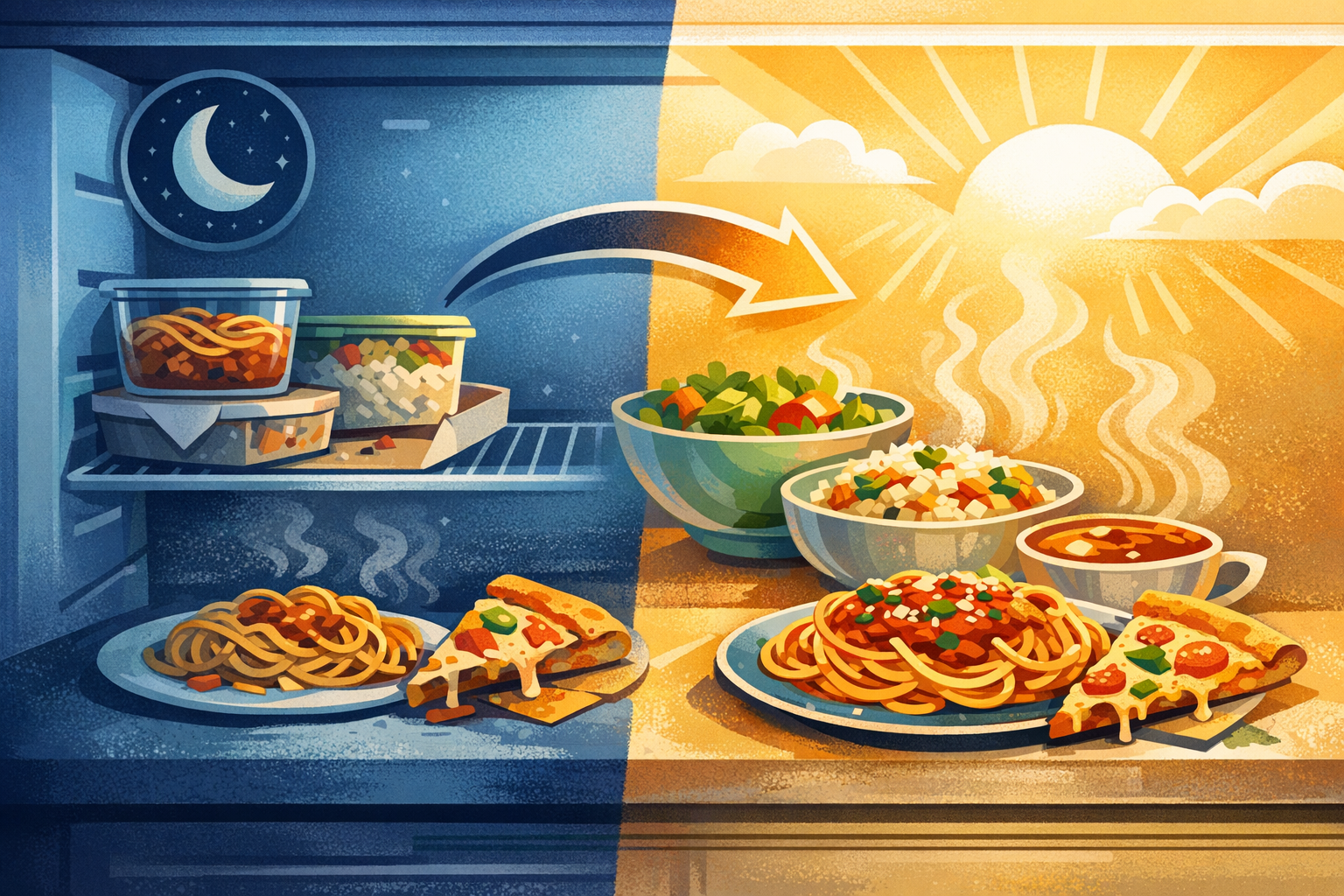
You've experienced this: the chili you made on Sunday tastes twice as good reheated on Monday. The curry that was perfectly fine at dinner becomes something transcendent at lunch the next day. Lasagna, stew, soup, meatloaf, braised short ribs, and nearly every slow-cooked dish share this puzzling characteristic. The leftovers taste better than the original.
This isn't nostalgia or lowered expectations. There are concrete chemical and physical processes happening inside your food between the time you put it in the fridge and the time you reheat it. Understanding these processes doesn't just satisfy curiosity; it can change how you plan meals, time dinner parties, and think about cooking in general.
Flavor Molecules Keep Moving After Cooking Stops
When you simmer a pot of chili, the heat is driving hundreds of chemical reactions simultaneously. Proteins break down. Sugars caramelize. Maillard reactions generate new flavor compounds at the interface between amino acids and sugars. Spices release essential oils. Garlic and onion undergo sulfur chemistry that creates pungent, sweet, and savory notes.
But here's the thing: not all of these reactions stop when you turn off the burner. Many flavor development processes are temperature-independent, meaning they continue (slowly) at refrigerator temperatures. Enzymatic reactions in particular keep working long after cooking ends. Enzymes in tomatoes continue breaking down cell walls, releasing more glutamate (umami). Enzymes in garlic and onion continue transforming sulfur compounds into milder, deeper, sweeter forms.
Researchers at the University of Nottingham's School of Biosciences have studied this phenomenon and found that certain classes of flavor compounds, particularly cyclic sulfur compounds and Maillard reaction products, continue to form and evolve for 12 to 24 hours after cooking at refrigeration temperatures. The food is literally developing new flavors while it sits in your fridge.
The Spice Integration Effect
Spices release their flavor compounds at different rates. Some are fast (like black pepper, which releases piperine quickly when heated), while others are slow (like cumin and coriander, whose essential oils migrate gradually through a liquid medium). During the overnight rest, these slower-releasing spices continue permeating the dish, and the fast-release spices mellow as their more volatile compounds dissipate or bind to proteins.
The net effect is that the spice profile becomes more unified and balanced. Instead of tasting individual spices in isolation, you taste a harmonious blend. This is especially noticeable in curries, gumbo, and any heavily spiced dish. Indian and Ethiopian cuisines, both of which use complex spice blends, have long-standing traditions of cooking dishes a day ahead specifically for this reason.
Starch Retrogradation: The Science of Texture Change
If you've ever noticed that day-old rice, pasta, or potatoes have a slightly firmer, chewier texture, you've witnessed starch retrogradation. This is one of the most well-studied phenomena in food science, and it has implications far beyond leftovers.
When starch granules are heated in water (gelatinization), the amylose and amylopectin molecules absorb water and swell, creating the soft, tender texture of freshly cooked rice or potatoes. As the food cools, the amylose molecules begin to re-crystallize, forming tighter, more ordered structures. This process is retrogradation.
Retrograded starch has a different texture (firmer, less sticky) and also becomes partially resistant to digestion. Nutritionists call this "resistant starch," and it behaves more like fiber in the body, feeding beneficial gut bacteria instead of being absorbed as glucose. This is why cold potato salad actually has a lower glycemic impact than hot mashed potatoes made from the same variety, a fact that has real significance for people managing blood sugar.
For cooking, retrogradation explains several practical truths. Day-old rice makes the best fried rice because the retrograded surface starches don't turn gummy in the high heat of a wok. Day-old bread makes better French toast because it absorbs custard more evenly without falling apart. Cold pasta salad has a satisfying bite that freshly cooked pasta doesn't.
Fat Redistribution and Flavor Carrying
Fat is the primary carrier of flavor in most savory cooking. Many of the compounds we identify as "flavor" are fat-soluble, meaning they dissolve in and are distributed by the fats in a dish. When a stew or braise first comes off the stove, the fat is hot, liquid, and distributed somewhat unevenly through the dish.
During refrigeration, that fat solidifies and then slowly redistributes as the dish equilibrates in temperature. Fat-soluble flavor compounds get carried along, spreading more evenly throughout the dish. When you reheat, the fat melts again and carries those now evenly-distributed flavors with it.
This is particularly noticeable in dishes with aromatic ingredients like garlic, herbs, and spices. The essential oils in these ingredients are overwhelmingly fat-soluble. In a freshly cooked dish, these oils might be concentrated in pockets near where the aromatics were added. After a night in the fridge, they've migrated throughout the fat phase of the dish, creating a more uniform and complete flavor experience.
The Gelatin Factor
Dishes made with collagen-rich cuts of meat (short ribs, oxtail, pork shoulder, chicken thighs on the bone) develop a remarkable body and richness when cooled and reheated. During the initial cook, collagen slowly converts to gelatin. When the dish cools, that gelatin sets, creating a jiggly, semi-solid consistency.
This isn't just a texture change. Gelatin coats the inside of your mouth in a way that liquid broth cannot, creating a sensation of richness and fullness that food scientists call "mouthfeel." When reheated, the gelatin melts back into the liquid but retains its mouth-coating properties at serving temperature. This is why a braised short rib stew that was merely good on day one can taste luxurious on day two.
Moisture Equalization
Freshly cooked food often has significant moisture gradients. The exterior of a roast is drier than the interior. The top of a casserole has less moisture than the bottom. Vegetables at the edge of the pot cooked differently than those in the center.
Overnight, moisture migrates from wet areas to dry areas through simple diffusion. The food reaches a state of equilibrium where moisture is more evenly distributed. When reheated, this translates to a more consistent texture throughout the dish. Each bite tastes like a complete, cohesive version of the whole rather than a random cross-section of different moisture levels.
This equalization is especially important for baked goods. A freshly baked banana bread might have a slightly gummy center and dry edges. By the next morning, moisture has migrated from the center outward, and the crumb is uniformly tender throughout. This is one reason many professional bakers let certain breads and cakes rest for a full day before slicing and serving.
Acid Mellowing and pH Stabilization
Many dishes contain acidic ingredients: tomatoes, wine, vinegar, citrus. When first added, these acids can taste sharp, bright, and somewhat one-dimensional. Overnight, the acid interacts with proteins, fats, and other molecules in the dish through a process called buffering.
Proteins in the dish absorb some of the free hydrogen ions that make acids taste sour. Fats coat the acid molecules, softening their perception on the tongue. The overall pH of the dish stabilizes into a less extreme range. The result is that the acidity integrates into the background, adding depth and brightness without the sharp edge.
This is why tomato sauce that tastes too acidic on day one is perfectly balanced on day two, without adding any sugar or baking soda. The chemistry took care of it overnight. Italian grandmothers who insist on making their ragù a day ahead aren't just being traditional; they're leveraging food chemistry.
Which Foods Improve Most (And Which Don't)
Not all foods benefit from resting overnight. The effect is most dramatic in:
Stews, braises, and soups: These are the gold standard. The combination of multiple ingredients, long cooking times that generate complex flavor compounds, and a liquid medium that allows molecular migration makes them ideal candidates for overnight improvement.
Curries and heavily spiced dishes: The spice integration effect is most pronounced in these. A Thai curry, Indian dal, or Moroccan tagine will taste noticeably more unified after 12 to 24 hours.
Chili: The textbook example. The complex interaction of beans (starch retrogradation), meat (gelatin formation), tomatoes (enzymatic glutamate release), and spices (slow essential oil diffusion) creates a dish that genuinely transforms overnight.
Meatloaf and meatballs: The binding proteins set more firmly, the seasonings distribute more evenly, and the fat redistributes to create a moister, more cohesive slice.
Casseroles and lasagna: Starch retrogradation firms up the pasta layers, fat redistribution evens out the cheese, and the sauce melds with the noodles.
Foods that don't improve
Crispy or fried foods: The enemy of crunch is moisture. Overnight, crispy exteriors absorb moisture from the interior and become soggy. Fried chicken, tempura, and french fries are always best fresh.
Delicate seafood: Fish and shellfish continue to break down and develop increasingly "fishy" flavors as trimethylamine oxide converts to trimethylamine. Seafood dishes are generally best eaten the day they're made.
Salads and raw preparations: Without heat-driven chemistry, the overnight changes are mostly negative (wilting, oxidation, textural degradation).
Pasta in sauce: While the sauce improves, the pasta itself continues to absorb liquid and becomes bloated and soft. This is why leftover pasta is best stored with the sauce separate, or why baked pasta dishes (where the pasta is already fully saturated) fare better.
Using This Knowledge in Your Kitchen
The practical applications here are significant. If you're hosting a dinner party, the smartest thing you can do is make your main course the day before. Not because you need the extra time (though that helps), but because the food will legitimately taste better.
For weekly meal prep, this science suggests a strategy: cook your base dishes (stews, soups, braises, curries) on Sunday and eat them Monday through Wednesday. The first serving will be the least flavorful, and each subsequent reheating will be a slight improvement as more flavor development occurs.
When developing a new recipe, taste it, then refrigerate a portion and taste again the next day. If the overnight version is dramatically better, your recipe might benefit from deeper initial seasoning, longer cooking, or a note suggesting it's best made ahead.
The next time someone apologizes for serving leftovers, tell them the truth: they're actually serving the best version of the dish.