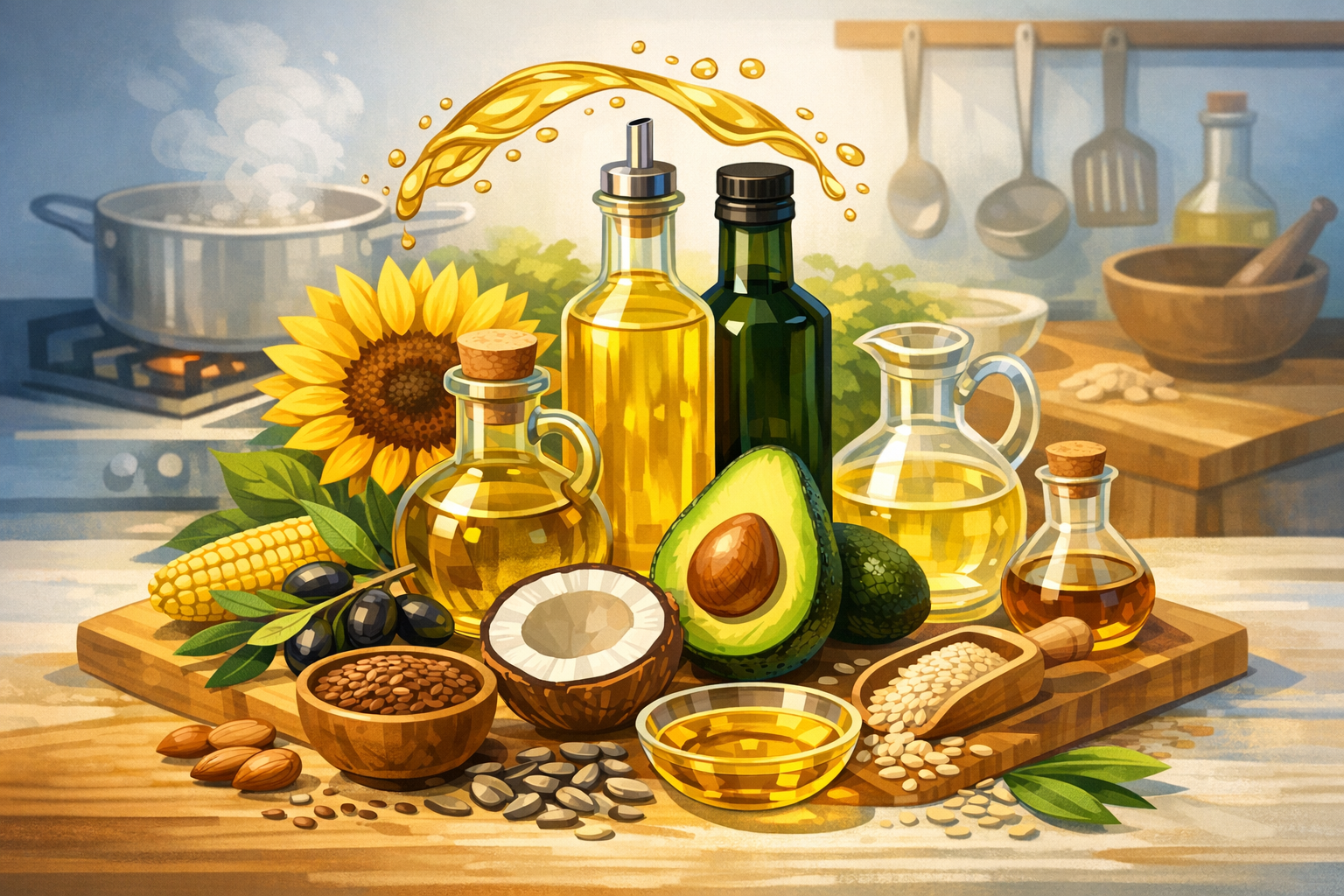
Reach into any home kitchen and you'll find at least three or four bottles of cooking oil. Olive oil for salad dressings, vegetable oil for frying, maybe some coconut oil tucked behind the spice rack. But ask most cooks why they grab one bottle over another and the answer is usually habit, not knowledge. That's a missed opportunity, because choosing the right oil for the right job is one of the simplest ways to make your food taste dramatically better.
Cooking oils aren't interchangeable. Each one has a distinct smoke point, flavor profile, fat composition, and best use case. Using extra virgin olive oil in a screaming-hot wok is a waste of good oil and a recipe for a smoke-filled kitchen. Drizzling refined canola over a Caprese salad when you could be using a grassy Tuscan olive oil is just sad. Understanding these differences doesn't require a chemistry degree. Just a willingness to think about what's actually happening in your pan.
This guide breaks down everything you need to know: what smoke points actually mean, how different fats behave under heat, which oils work best for which cooking methods, and how to store them so they don't go rancid in your cabinet.
What Smoke Point Really Means (And Why It Matters)
Smoke point is the temperature at which an oil begins to break down and produce visible smoke. This isn't just an aesthetic problem. When oil passes its smoke point, it starts decomposing into glycerol and free fatty acids, then further into acrolein, the compound responsible for that acrid, burnt smell that clings to your kitchen for hours. The food cooked in overheated oil picks up bitter, unpleasant flavors that no amount of seasoning can fix.
But smoke point isn't the whole story. The number you see listed on a chart, 450°F for avocado oil, 320°F for unrefined coconut oil, represents the temperature in a lab setting with fresh oil. In your kitchen, the actual smoke point drops every time you reuse oil, and it varies depending on the oil's age, how it was processed, and even the acidity of the food you're cooking in it. A bottle of extra virgin olive oil that's been open for six months will smoke at a lower temperature than a freshly opened one.
What matters practically is matching your oil to your cooking method. High-heat searing and deep-frying need oils with smoke points above 400°F. Sautéing and roasting at moderate temperatures work well with oils in the 350-400°F range. Anything below 325°F is best reserved for dressings, finishing drizzles, and low-heat cooking.
Common Smoke Points at a Glance
Avocado oil leads the pack at roughly 520°F, making it nearly bulletproof for any cooking method. Refined safflower and sunflower oils sit around 450°F. Light (refined) olive oil hits about 465°F. Much higher than most people realize. Ghee comes in at 485°F, which is why Indian cooking relies on it for high-heat work. On the lower end, unrefined walnut oil smokes at just 320°F, and unrefined flaxseed oil at a mere 225°F. These are finishing oils only.
Extra virgin olive oil deserves special mention because its smoke point (around 375-405°F depending on quality) is widely misunderstood. Plenty of cooks believe you can't sauté with it, which isn't true. You absolutely can sauté vegetables or pan-fry chicken in extra virgin olive oil at normal stovetop temperatures. What you shouldn't do is use it for deep-frying at 375°F or blast it in a wok at 500°F.
Breaking Down the Major Cooking Oils
Extra Virgin Olive Oil
The backbone of Mediterranean cooking and arguably the most versatile oil in any kitchen. Good extra virgin olive oil has a fruity, sometimes peppery flavor that comes from polyphenols. Antioxidant compounds that also happen to be heat-sensitive. This is why finishing a dish with a raw drizzle of high-quality EVOO tastes so much better than cooking with it.
For everyday cooking, a mid-range extra virgin olive oil works perfectly for sautéing vegetables, making pan sauces, roasting at temperatures up to 400°F, and shallow-frying. Save the expensive single-estate bottles for raw applications: salad dressings, dipping bread, drizzling over soups, finishing grilled fish.
One thing that surprises many cooks: extra virgin olive oil is actually more stable under heat than most seed oils, despite having a lower smoke point. Research published in the journal ACTA Scientific Nutritional Health found that EVOO produced fewer harmful polar compounds when heated than canola, grapeseed, and rice bran oils. The polyphenols and oleic acid act as natural antioxidants that resist degradation.
Avocado Oil
If you need one oil that handles everything, avocado oil is hard to beat. Its neutral flavor won't compete with your ingredients, its smoke point of 520°F can handle any cooking method, and its fat profile (about 70% monounsaturated oleic acid) is nearly identical to olive oil's. It's the oil you want for searing steaks, stir-frying, grilling, and making mayonnaise.
The catch is price. Quality avocado oil costs roughly three to four times more than olive oil per ounce. And quality matters. A 2020 study from the University of California, Davis found that 82% of avocado oils tested were either rancid or adulterated with cheaper oils. Look for brands that are certified by third-party testing and stored in dark glass bottles.
Neutral Seed Oils: Canola, Vegetable, Sunflower
These workhorses won't win any flavor awards, but they're cheap, widely available, and have high smoke points (400-450°F). Canola oil, actually made from a cultivar of rapeseed bred in Canada in the 1970s, has a reasonably good fat profile with low saturated fat and decent omega-3 content. Vegetable oil is usually soybean oil, sometimes blended with other seed oils.
These are the oils for deep-frying, baking when you want no oil flavor, and any high-heat cooking where the oil is a vehicle for heat transfer rather than a flavor component. They're fine for what they are. Don't let anyone tell you they're poison, but also don't drizzle them over finished dishes expecting anything interesting to happen.
Coconut Oil
Coconut oil is unusual because it's about 82% saturated fat, which means it's solid at room temperature and extremely stable under heat. Unrefined (virgin) coconut oil has a distinct coconut flavor and aroma with a smoke point around 350°F. Perfect for curries, Southeast Asian stir-fries, and baking where coconut flavor is welcome. Refined coconut oil is flavor-neutral with a higher smoke point of about 400°F.
The saturated fat content has made coconut oil controversial. The American Heart Association still recommends limiting saturated fat intake, and coconut oil will raise LDL cholesterol. However, it also raises HDL cholesterol, and the medium-chain triglycerides (MCTs) in coconut oil are metabolized differently than the long-chain saturated fats in butter. The honest answer is that coconut oil is probably fine in moderation, used where its unique properties shine. But it shouldn't be your only cooking fat.
Sesame Oil
Two completely different products share this name. Light sesame oil, pressed from raw sesame seeds, has a mild nutty flavor and a smoke point around 410°F. It's a solid cooking oil common in Chinese and Korean kitchens. Toasted sesame oil, pressed from roasted seeds, has an intense, smoky flavor and a much lower smoke point. Toasted sesame oil is a finishing oil. A few drops transform a stir-fry, noodle dish, or dumpling dipping sauce.
A common mistake is using toasted sesame oil as your primary cooking fat. At high heat it burns quickly and turns bitter. Use light sesame oil for cooking and add toasted sesame oil at the end, off heat.
Ghee and Butter
Butter adds incredible flavor but burns at around 300°F because of its milk solids. Clarified butter (ghee) solves this problem by removing those solids entirely, pushing the smoke point up to 485°F while retaining a rich, nutty, buttery flavor. This is why ghee is the traditional cooking fat across much of South Asia. It handles high-heat cooking beautifully.
Ghee is also shelf-stable and doesn't need refrigeration, since the milk solids that cause butter to spoil have been removed. It's worth making at home: simmer unsalted butter until the milk solids turn golden brown and settle to the bottom, then strain through cheesecloth. The whole process takes about 20 minutes and yields a jar of liquid gold that lasts for months.
Matching Oil to Cooking Method
The simplest framework is to think about temperature and flavor:
Deep-frying (350-375°F): Use refined peanut oil for the best flavor (especially for fried chicken and Asian dishes), or avocado oil for a neutral option. Canola and vegetable oil work fine too. You need an oil with a smoke point well above your frying temperature because the oil sits at that heat for extended periods.
Searing and wok cooking (400-500°F): Avocado oil is the top choice. Ghee works beautifully for searing steaks. Light sesame oil is traditional for wok cooking. Refined safflower and sunflower oils are good budget options.
Sautéing and pan-frying (300-375°F): This is where you have the most freedom. Extra virgin olive oil, butter, coconut oil, avocado oil. Pick based on the flavor you want. Olive oil for Mediterranean dishes, coconut oil for Thai curries, butter for French cooking, ghee for Indian.
Roasting (375-450°F): Extra virgin olive oil is the classic choice and works perfectly up to 425°F. For higher-temperature roasting, switch to avocado oil. Toss vegetables with oil before roasting rather than adding it to a cold pan.
Dressings, dips, and finishing: This is where expensive, flavorful oils earn their keep. High-quality extra virgin olive oil, toasted sesame oil, walnut oil, truffle oil, chili oil. These should never see high heat. Their flavors are volatile and dissipate quickly when cooked.
Storage: How to Keep Your Oils From Going Rancid
Rancidity is the oxidation of fats, and it happens to every oil eventually. The enemies are heat, light, and air. Which is unfortunate, since most people store their oils right next to the stove in clear bottles. Rancid oil won't make you sick immediately, but it tastes stale and slightly fishy, ruins the flavor of whatever you cook with it, and produces harmful free radicals.
Polyunsaturated oils (walnut, flaxseed, grapeseed) go rancid fastest. Often within a few weeks of opening. Store these in the refrigerator. Monounsaturated oils (olive, avocado) last longer, typically 6-12 months after opening if stored in a cool, dark cabinet away from the stove. Saturated fats (coconut oil, ghee) are the most stable and can last over a year.
Buy oils in dark glass bottles when possible, as light accelerates oxidation. If you buy oil in a large clear container, transfer some to a smaller dark bottle for daily use and keep the rest sealed in a cool pantry. Always close the cap tightly after use. Oxygen exposure is the primary driver of rancidity once the bottle is open.
Here's a quick test: smell your oil before using it. Fresh oil smells clean. Nutty, grassy, fruity, or neutral depending on the type. Rancid oil smells like crayons, old paint, or Play-Doh. If you catch even a whiff of that, throw it out. Cooking with rancid oil makes your food taste worse in subtle ways you might not even consciously identify, just a general flatness or off-note that you can't quite place.
Building Your Oil Collection
You don't need a dozen bottles. Most home cooks can cover every situation with just three or four oils:
The essentials: A good everyday extra virgin olive oil for sautéing, roasting, and dressings. Avocado oil for high-heat searing and stir-frying. Unsalted butter or ghee for when you want that rich, dairy flavor.
Nice to have: Toasted sesame oil for Asian dishes (a bottle lasts ages since you use so little). Coconut oil if you cook Southeast Asian or Indian food regularly. A neutral oil like canola for deep-frying and baking.
Specialty: A high-quality finishing olive oil for special dishes. Walnut or pistachio oil for salads. Chili oil for heat. These are luxuries, not necessities.
The most important thing isn't which oils you buy. It's using the right one at the right time and replacing them before they go rancid. A fresh bottle of mid-range olive oil will always outperform an expensive bottle that's been sitting open next to your stove for a year. Buy what you'll actually use up within a few months, store it properly, and pay attention to what's happening in your pan. That alone puts you ahead of most home cooks.