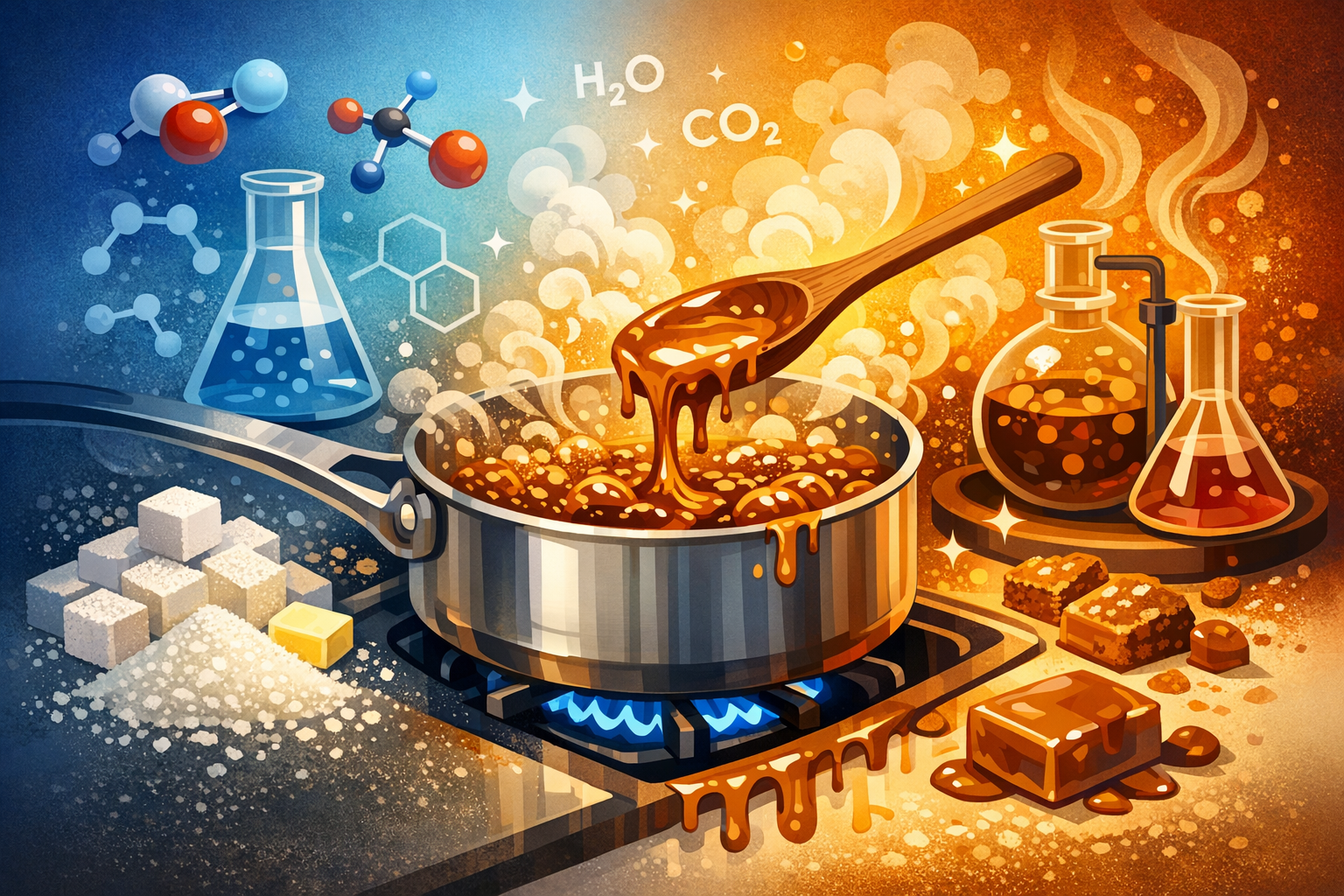
Every cook has experienced the moment when pale, unassuming ingredients suddenly become something extraordinary. Onions turn from sharp and pungent to sweet and golden. A piece of bread becomes toast. A spoonful of white sugar melts into amber liquid with the aroma of butterscotch. This transformation has a name: caramelization. And understanding the chemistry behind it will make you a significantly better cook.
Caramelization is one of the most important chemical reactions in your kitchen, yet most home cooks treat it as an afterthought. They follow instructions to "cook until golden brown" without understanding what's actually happening at a molecular level, or why those extra few minutes of patience yield such dramatically different results. Once you grasp the science, you'll start making better decisions about heat, timing, and technique across dozens of recipes.
What Caramelization Actually Is
At its core, caramelization is the thermal decomposition of sugar. When you heat any sugar past its melting point, the molecules begin to break apart and recombine into hundreds of new compounds. These new molecules are responsible for the brown color, the complex flavors, and the distinctive aromas we associate with caramelized food.
The process begins when sugar reaches approximately 320°F (160°C), though this varies by sugar type. Fructose, the sugar found in fruits and honey, begins caramelizing at around 230°F (110°C). Sucrose, ordinary table sugar, starts at 320°F. Glucose, common in corn syrup and many processed foods, requires about 300°F (150°C). This is why honey browns so much faster than table sugar when you heat them side by side.
As the temperature rises, a cascade of chemical reactions unfolds. First, the sugar molecules lose water through a process called dehydration. Then they begin breaking into smaller fragments. These fragments recombine with each other in unpredictable ways, creating a staggering variety of new compounds. Scientists have identified over 100 distinct molecules produced during sugar caramelization, and the real number is likely much higher.
Among these products are diacetyl, which contributes a buttery flavor; furanones, which taste like caramel and butterscotch; and maltol, which adds a toasty sweetness. The brown color comes from polymers called melanoidins, large molecules that form as smaller fragments link together into chains.
The Temperature Sweet Spot
The difference between perfectly caramelized and burnt is often just 20 to 30 degrees. Between 320°F and 350°F, you get the sweet, complex flavors most people love. Push past 380°F and the compounds become increasingly bitter as carbon-heavy molecules dominate. By 410°F, you're well into burnt territory, producing acrid flavors that overwhelm anything pleasant.
This narrow window explains why caramelization requires attention. Unlike boiling water, which stays at 212°F no matter how high you crank the burner, sugar in a pan keeps getting hotter as long as heat is applied. The reaction also accelerates as temperature rises, which means the transition from perfect to ruined happens faster the longer you cook.
Caramelization vs. the Maillard Reaction
Home cooks frequently confuse caramelization with the Maillard reaction, and for good reason: both produce brown colors and complex flavors. But they are fundamentally different chemical processes.
Caramelization involves only sugar and heat. The Maillard reaction requires both sugar and amino acids (the building blocks of proteins). When you sear a steak, the browning on the surface is primarily the Maillard reaction, because meat contains both sugars and proteins. When you make caramel sauce from pure sugar, that's caramelization.
In practice, most cooking involves both reactions happening simultaneously. Onions contain sugars and proteins, so when you brown them in a pan, both caramelization and Maillard reactions contribute to the final flavor. The same is true for roasted vegetables, baked bread, and grilled fruit.
The Maillard reaction begins at a lower temperature, around 280°F (140°C), which is why it often gets a head start. It also produces a different set of flavor compounds, including pyrazines (nutty, roasted notes) and thiophenes (meaty flavors). The interplay between these two reactions is what makes a perfectly roasted chicken taste so much more complex than either reaction could achieve alone.
Why This Distinction Matters in Your Kitchen
Understanding the difference helps you control outcomes. If you want pure caramel sweetness, you want to minimize the Maillard reaction by using refined sugar with no protein present. If you want deep, savory complexity on a roasted vegetable, you can boost the Maillard reaction by adding a small amount of protein, such as a brush of milk or a sprinkle of baking soda to raise the pH (the Maillard reaction accelerates in alkaline conditions).
This is exactly why many professional recipes for caramelized onions include a pinch of baking soda. It raises the pH of the onions, speeding up Maillard browning and reducing cooking time from 45 minutes to about 15, while also promoting deeper color development.
Practical Applications: Onions, Vegetables, and Beyond
Caramelized onions are perhaps the most common application of this chemistry in home cooking, and they're also the most frequently botched. The fundamental mistake most people make is using too much heat.
When you cook onions over high heat, the exterior browns quickly through the Maillard reaction, but the interior sugars never get hot enough to caramelize properly. You end up with onions that are brown on the outside but still sharp-tasting and crunchy in the middle. True caramelization requires patience: medium to medium-low heat for 30 to 45 minutes, stirring occasionally, allowing the internal temperature of the onion pieces to rise slowly and evenly.
The water content of onions plays a critical role here. Raw onions are about 89% water by weight. All of that water must evaporate before the temperature can rise above 212°F, which is the threshold where browning begins. This is why the first 15 minutes of cooking onions feel unproductive. The onions are merely sweating, releasing water and steaming. The actual caramelization doesn't begin until most of that moisture is gone.
Root vegetables follow similar principles. Carrots, parsnips, and sweet potatoes all contain significant natural sugars that caramelize beautifully at high roasting temperatures. The key is cutting them into pieces that are large enough to develop a good crust but small enough that the interior cooks through. A half-inch dice is ideal for most root vegetables roasted at 425°F.
The Role of Fat
Fat serves as a heat transfer medium during caramelization. When you roast vegetables in oil, the fat fills the microscopic gaps between the food surface and the pan, ensuring even contact and consistent heat delivery. Without fat, you get spotty browning, with some areas charred and others pale.
The type of fat matters less than its presence, though fats with higher smoke points (avocado oil, refined coconut oil, ghee) allow you to push temperatures higher without the fat itself burning and producing off-flavors.
Sugar Caramelization: Wet Method vs. Dry Method
When making caramel from granulated sugar, you have two approaches, and each has distinct advantages.
The dry method involves simply pouring sugar into a pan and heating it. The sugar at the bottom melts first and begins to brown, so you must stir or swirl constantly to prevent burning in hot spots. This method is faster and produces a slightly more intense caramel flavor, but it's less forgiving. Crystallization is a constant threat: if even a few undissolved sugar crystals fall into the melting sugar, they can trigger a chain reaction that turns your smooth caramel into a grainy mess.
The wet method starts by dissolving sugar in water (typically a ratio of one part water to three parts sugar). You bring this syrup to a boil without stirring, then let the water evaporate. Once the water is gone, the concentrated sugar begins to caramelize. This method is slower but much more reliable. The water dissolves any rogue crystals, and the even distribution of heat through the liquid phase produces consistent results.
Professional pastry chefs almost universally prefer the wet method for its predictability. Many also add a small amount of corn syrup or a few drops of lemon juice to the sugar solution. Both of these additives are "interfering agents" that prevent crystallization by introducing different sugar molecules (glucose from corn syrup) or breaking down sucrose into glucose and fructose (via the acid in lemon juice). These different-shaped molecules physically prevent the sucrose from locking into a crystal lattice.
Advanced Techniques: Controlling Caramelization Like a Professional
Once you understand the basics, you can start manipulating caramelization to achieve specific results.
Acid and Alkalinity
The pH of your cooking environment significantly affects both the rate and character of caramelization. Acidic conditions (a squeeze of lemon, a splash of vinegar) slow caramelization and produce sharper, more fruit-forward flavor compounds. Alkaline conditions (baking soda) accelerate browning dramatically and push the flavor profile toward deeper, more bitter-sweet notes.
This explains a classic pastry technique: adding a tiny pinch of baking soda to dulce de leche recipes. The alkaline environment speeds up the Maillard reaction between the milk proteins and lactose, producing that distinctive dark color and complex toffee flavor in a fraction of the usual time.
Moisture Management
Water is the enemy of browning. Since water boils at 212°F and caramelization begins around 300°F or above, no browning can occur as long as surface moisture remains. This is why patting meat dry before searing is so important, and why crowding a pan (which traps steam) prevents proper browning.
For vegetables, the same principle applies. Roasting on a wire rack instead of a sheet pan allows moisture to drip away from the surface, promoting faster and more even browning. Pre-salting vegetables 20 to 30 minutes before roasting draws out surface moisture through osmosis, giving you a head start on the evaporation phase.
Sugar Selection
Different sugars caramelize at different temperatures and produce different flavor profiles. Fructose produces more hydroxymethylfurfural (HMF), which has a pronounced caramel and slightly burnt flavor. Sucrose produces a more balanced, classic caramel taste. Glucose tends toward milder, less assertive flavors.
You can exploit these differences. When making a sauce where you want aggressive caramel flavor, use honey (high fructose). For a gentler, more rounded sweetness in a dessert, use regular granulated sugar. For glazes where you want browning without strong caramel notes, corn syrup (glucose) works beautifully.
Common Mistakes and How to Fix Them
The most frequent caramelization mistakes all trace back to the same root causes: too much heat, too little patience, or too much moisture.
If your caramelized onions taste bitter, you cooked them too hot. Start over at a lower temperature. If they taste sharp and lack sweetness even after 20 minutes of cooking, you probably have too much moisture in the pan, likely from crowding. Use a wider pan or work in batches.
If your caramel sauce crystallized, stir less (for the wet method, don't stir at all once it boils) and make sure your pan and utensils are scrupulously clean. Even a grain of stray sugar or a particle of dust can seed crystallization.
If roasted vegetables emerge from the oven pale and steamed, the culprits are almost certainly overcrowding and insufficient oven temperature. Spread them in a single layer with space between pieces, roast at 425°F or higher, and make sure your oven is fully preheated before the pan goes in.
Understanding these principles transforms caramelization from a mysterious, inconsistent process into a reliable tool you can deploy with confidence. The next time a recipe tells you to "cook until golden brown," you'll know exactly what's happening in that pan, and you'll know how to make it happen perfectly every time.