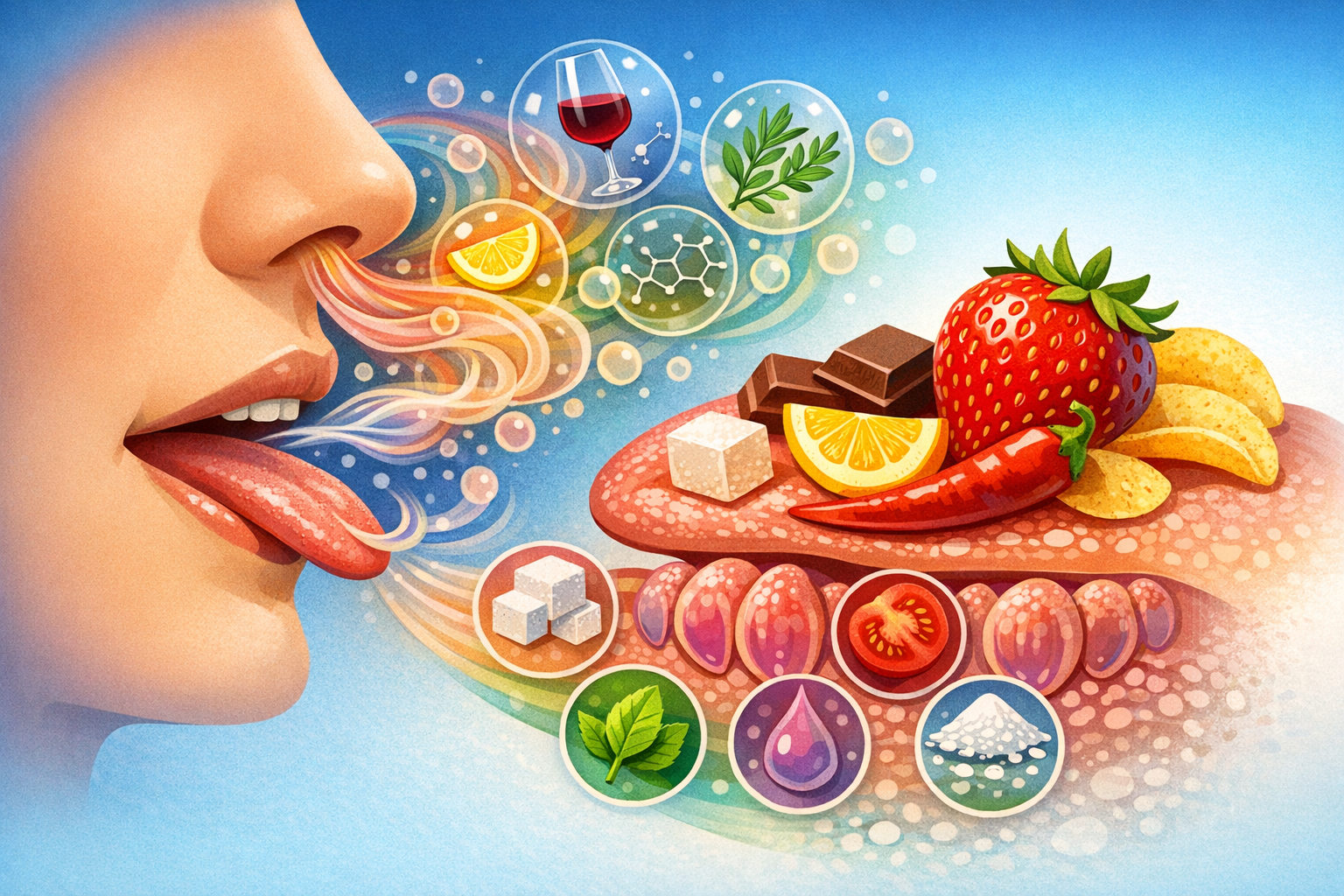
Close your eyes and think about biting into a fresh strawberry. You can almost taste it: sweet, slightly tart, with that unmistakable strawberry-ness that no artificial flavoring quite captures. Now consider this: if you held your nose while eating that same strawberry, you'd taste something sweet and sour, but you wouldn't be able to identify it as a strawberry at all. It could be a cherry, a raspberry, or any number of fruits.
This simple experiment reveals a truth that surprises most people: the vast majority of what we call "taste" is actually smell. Your tongue can detect only five basic tastes. Your nose, meanwhile, can distinguish over 10,000 distinct odor molecules. The rich, complex, multidimensional experience we call flavor is a construction of the brain, built by combining inputs from taste, smell, touch, temperature, and even sound into a unified sensory experience.
For cooks, understanding flavor biology isn't just academic trivia. It's a practical toolkit. When you know how the human sensory system processes food, you can build dishes that are more satisfying, more complex, and more memorable. You can also diagnose why a dish feels flat and fix it.
The Five Basic Tastes
Your tongue is covered with taste buds, roughly 10,000 of them in an average adult. Each taste bud contains 50 to 100 receptor cells that detect dissolved chemical compounds in food. These receptors are tuned to five distinct taste categories.
Sweet signals the presence of sugars and, by evolutionary extension, caloric energy. Sweetness receptors respond to sucrose, fructose, glucose, and also to certain amino acids and alcohols. The reason artificial sweeteners work is that their molecular shape happens to fit the sweetness receptor, triggering the same signal even though they contain no calories.
Sour detects acids. The intensity of sourness correlates with the concentration of hydrogen ions (pH). Citric acid in lemons, acetic acid in vinegar, lactic acid in yogurt, and tartaric acid in wine all trigger the sour response. Sourness serves as both a warning (extremely sour foods may be spoiled or dangerous) and a pleasure signal at moderate levels (a squeeze of lime brightens nearly any dish).
Salty responds to sodium ions, and to a lesser extent potassium and other mineral ions. Salt taste is unusual in that it's both a warning at high concentrations (ocean water tastes repulsive) and intensely pleasurable at moderate levels. This dual nature reflects our evolutionary need for sodium: enough to maintain cellular function, not so much that it disrupts our electrolyte balance.
Bitter detects a wide variety of compounds, many of which are toxic in nature. Humans have about 25 different bitter taste receptors, more than for any other taste, which reflects the evolutionary importance of detecting poisons. However, many bitter compounds are perfectly safe and culinarily valuable: caffeine in coffee, polyphenols in dark chocolate, hoppy compounds in beer, and the glucosinolates in cruciferous vegetables like broccoli and Brussels sprouts.
Umami is the taste of glutamate, an amino acid abundant in protein-rich foods. Identified in 1908 by Japanese chemist Kikunae Ikeda, umami was not widely accepted as a distinct taste in Western science until the early 2000s, when the specific taste receptors were identified. Umami-rich foods include aged cheeses (Parmesan contains one of the highest concentrations of free glutamate of any food), fermented soy products, cured meats, fish sauce, mushrooms, and ripe tomatoes.
What's notable about this list is how limited it is. Five tastes cannot account for the thousands of distinct flavors we experience. The difference between a peach and a mango, between basil and cilantro, between coffee and chocolate: none of these distinctions come from the five basic tastes. They come from smell.
Retronasal Olfaction: The Real Engine of Flavor
When most people think of smelling food, they think of sniffing: drawing air in through the nostrils to detect aromas rising from a plate. This is orthonasal olfaction, and while it contributes to the anticipation and initial experience of eating, it's not the primary way smell shapes flavor.
The real work happens retronasally. When you chew and swallow food, volatile aroma compounds are released from the food inside your mouth. These compounds travel up through the passage connecting the back of your throat to your nasal cavity (the nasopharynx). They reach the olfactory receptors in your nose from behind, via an internal route rather than from the outside air.
This retronasal pathway is why food becomes tasteless when you have a cold. Nasal congestion blocks the nasopharynx, preventing aroma molecules from reaching the olfactory receptors. Your tongue still works perfectly (you can detect sweet, sour, salty, bitter, and umami), but without the olfactory component, flavor collapses into something flat and unrecognizable.
The retronasal pathway also explains why the experience of chewing is so different from the experience of sniffing. The same wine smells one way when you swirl it and sniff (orthonasal) and tastes somewhat differently when you sip and swish it in your mouth (retronasal). Warming the wine in your mouth and mixing it with saliva releases different proportions of volatile compounds than those that evaporate from the glass at room temperature.
For cooks, this has a practical implication: the temperature at which food is served affects which aroma compounds are released retronasally. Hot food releases more volatiles, which is why hot soup tastes more flavorful than cold soup (and why cold leftover pizza, while enjoyable, has a muted flavor compared to fresh). Conversely, frozen desserts need higher concentrations of flavoring than room-temperature ones because cold temperatures suppress volatile release.
The Other Senses: Touch, Temperature, and Sound
Flavor perception extends well beyond taste and smell. The trigeminal nerve, which innervates the face and mouth, detects physical and chemical sensations that profoundly affect how we experience food.
Chemesthesis: Chemical Touch
Spiciness is not a taste. Capsaicin (in chili peppers), piperine (in black pepper), gingerol (in ginger), and allyl isothiocyanate (in wasabi and horseradish) don't activate taste buds. They activate pain and temperature receptors on the trigeminal nerve. Capsaicin literally tricks your mouth into thinking it's being burned.
Menthol, from mint, triggers cold receptors, which is why peppermint creates a cooling sensation even at room temperature. The tingling of Sichuan pepper (from the compound hydroxy-alpha-sanshool) activates touch receptors that normally detect vibration, creating a unique buzzing numbness called "ma" in Chinese cuisine.
These trigeminal sensations interact powerfully with taste and smell. A few drops of hot sauce can make a bland dish seem more flavorful, not because capsaicin has flavor, but because the pain signal heightens attention to the other sensory inputs. This is why a squeeze of lime and a shake of chili powder can rescue a mediocre taco: the acid, the heat, and the lime aroma together create a sensory experience that's more than the sum of its parts.
Texture
The mechanical properties of food, its crunch, creaminess, chewiness, crispness, silkiness, or grittiness, are detected by pressure-sensitive nerves in the tongue, palate, teeth, and jaw. These textural signals contribute substantially to perceived flavor.
A classic demonstration: take two identical chocolate puddings and add a tiny amount of cornstarch to one, creating a slightly grainy texture. Most people will rate the grainy version as less flavorful, even though the chemical composition (and therefore the taste and aroma) is virtually identical. The textural signal contaminates the flavor perception.
This is why professional cooks obsess over texture. A perfectly seared steak doesn't just taste better because of the Maillard reaction; the crispy crust provides a textural contrast with the tender interior that the brain interprets as a more complex, satisfying experience. A salad with croutons, nuts, or seeds is more compelling than the same salad without them, because the crunch provides a counterpoint to the soft leaves.
Sound
This may seem far-fetched, but research consistently shows that sound affects flavor perception. The crunch of a potato chip, amplified through bone conduction as you chew, contributes to the perception of freshness and crispness. In studies where the crunching sound was muffled through headphones, participants rated identical chips as staler and less enjoyable.
Charles Spence, a professor of experimental psychology at Oxford, has demonstrated that background music can shift flavor perception. Higher-pitched sounds enhance perceived sweetness; lower-pitched sounds enhance bitterness. Some restaurants have begun curating soundtracks specifically to complement their menus.
Flavor Balancing: Practical Applications
Understanding the components of flavor gives you a systematic approach to building and fixing dishes.
The Four Balancing Levers
Most successful dishes maintain a balance among four sensory dimensions: saltiness, acidity, sweetness, and richness (fat). Bitterness and umami play supporting roles.
When a dish tastes flat or one-dimensional, it's usually missing one of these components.
If food tastes dull and lifeless, it probably needs salt. Salt is the most powerful flavor amplifier in cooking. At proper levels, it doesn't make food taste salty; it makes food taste more like itself. This is because sodium ions suppress bitter taste receptors while enhancing sweet and umami receptors. A properly salted tomato sauce tastes more tomatoey, not saltier.
If food tastes heavy, rich, or cloying, it needs acid. A squeeze of lemon over buttery pasta, a splash of vinegar in a beef stew, a pickle alongside a fatty sandwich: acid cuts through richness by stimulating salivation (which literally dilutes the fat coating your palate) and by providing a sharp contrast that resets the flavor experience.
If food tastes sharp, harsh, or one-note, it may need sweetness or fat. A pinch of sugar in tomato sauce rounds out the acidity. A drizzle of olive oil over a sharp salad smooths the edges. Fat carries flavor compounds and delivers them to your taste receptors more slowly, extending and softening the flavor experience.
If food tastes good but not special, it probably needs umami. A spoonful of miso stirred into soup, a grating of Parmesan over vegetables, a dash of soy sauce in a vinaigrette, or a few anchovies melted into a pasta sauce adds a depth and savoriness that the other tastes cannot provide. Umami is the background hum that makes everything else sound richer.
Building Complexity Through Contrast
The most memorable dishes create tension between opposing sensory elements. Sweet and sour (pad thai). Salty and sweet (salted caramel). Crunchy and creamy (fried chicken with mashed potatoes). Hot and cold (warm apple pie with ice cream). Spicy and cooling (chili with sour cream).
These contrasts work because the brain pays more attention to changing stimuli than to constant ones. A dish that delivers the same sensation with every bite becomes monotonous, no matter how good that sensation is. A dish that oscillates between contrasting sensations keeps the brain engaged and interested.
This is the neurological basis for the culinary principle of contrast. It's not just aesthetic preference; it's hardwired into how our sensory processing works.
Aroma Layering
Since aroma accounts for most of flavor, building aromatic complexity is one of the most effective ways to improve your cooking.
Professional kitchens create layers of aroma by adding aromatic ingredients at different stages of cooking. Early aromatics (onions, garlic, spices sauteed at the beginning) develop deep, caramelized, muted notes. Mid-cooking aromatics (herbs added to a simmering sauce) infuse the base with herbal complexity. Finishing aromatics (fresh herbs, citrus zest, a drizzle of flavored oil added just before serving) provide bright, volatile top notes that hit the nose immediately.
This three-layer approach, base, middle, and top notes, mirrors how perfumers construct fragrances and how winemakers think about complexity. A dish with only one aromatic layer (say, garlic added at the start) will smell good but simple. A dish with all three layers will smell complex and intriguing in a way that's hard to articulate but easy to recognize.
Why Individual Perception Varies
Not everyone experiences the same food in the same way, and the reasons are both genetic and environmental.
About 25% of the population are "supertasters," meaning they have significantly more taste buds than average and experience bitter, sweet, and fatty sensations more intensely. Supertasters tend to dislike bitter vegetables, strong cheeses, and very spicy food. Another 25% are "non-tasters" who have fewer taste buds and experience flavors less intensely, often gravitating toward bolder, spicier food to compensate.
Genetic variation in olfactory receptors also plays a role. The gene OR6A2, for example, affects how people perceive the aldehyde compounds in cilantro. People with certain variants of this gene perceive cilantro as soapy and unpleasant, while others find it fresh and pleasant. Neither group is wrong; they're literally smelling different things.
Age diminishes both taste and smell acuity. Adults over 60 typically have fewer functioning taste buds and reduced olfactory sensitivity, which is one reason elderly people often complain that food "doesn't taste like it used to." Increasing salt, acidity, and aromatic intensity in cooking for older adults can partially compensate for this sensory decline.
Understanding that flavor is subjective, constructed, and highly variable should make you both a more empathetic cook and a more creative one. When someone says they don't like a dish you love, they may be experiencing it in a genuinely different way than you are. And when you learn to work with the biology rather than against it, you gain the ability to create food that resonates on a level deeper than any recipe can prescribe.