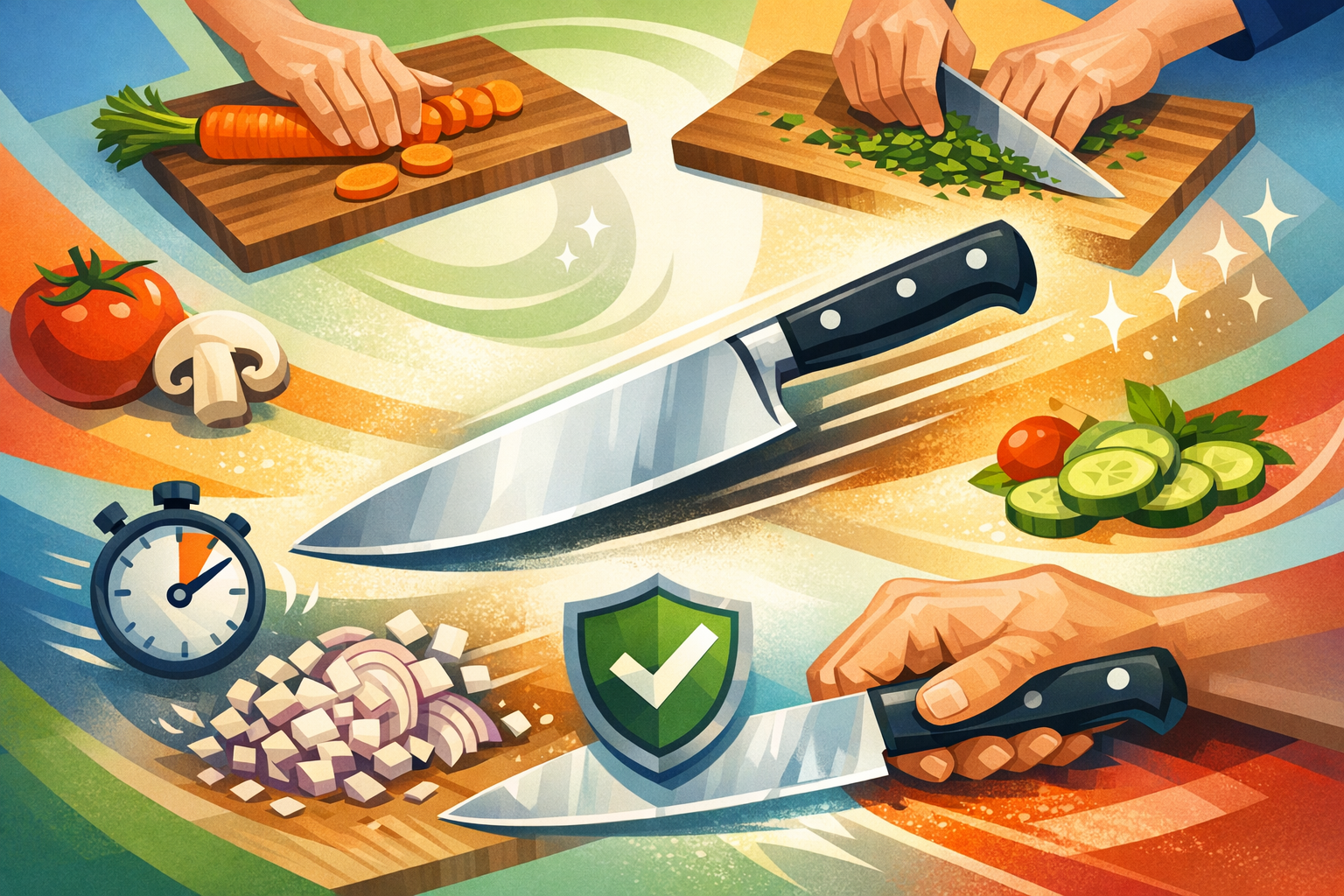
Ask any professional chef what single skill separates competent home cooks from accomplished ones, and the answer is almost always the same: knife work. Not flavor intuition, not timing, not plating. Knife skills.
This might seem surprising until you consider how much time a cook actually spends with a knife in hand. Professional chefs estimate that 60% to 80% of their active cooking time involves cutting, slicing, dicing, and mincing. For home cooks, the proportion is even higher, since professionals have prep cooks to share the load. If you cook dinner five nights a week, you probably spend two to three hours each week doing knife work. Over a year, that's 100 to 150 hours. Over a lifetime of cooking, it's thousands.
Small improvements in knife technique compound dramatically over that kind of timeframe. Learning to dice an onion in 30 seconds instead of two minutes saves almost 15 hours per year if you cook with onions regularly. More importantly, proper technique is inherently safer. The vast majority of kitchen cuts happen because of poor grip, a dull blade, or unstable cutting surfaces, all of which are correctable.
Choosing the Right Knife
Before discussing technique, let's address equipment. You don't need a large collection of knives. Professional kitchens typically rely on three:
The chef's knife (8 to 10 inches) handles 90% of all cutting tasks. It's long enough for efficient rocking and slicing motions, heavy enough to power through dense vegetables, and versatile enough for everything from mincing herbs to breaking down a chicken. If you own only one good knife, this should be it.
An 8-inch chef's knife is the most popular size for home cooks. People with smaller hands or those who find a full-size chef's knife intimidating may prefer a 7-inch santoku, which is lighter, shorter, and has a flatter blade profile. Both accomplish the same tasks; the choice is largely about comfort.
The paring knife (3 to 4 inches) handles detail work: peeling, trimming, deveining shrimp, hulling strawberries, and any task where a large knife would be clumsy. Think of it as your precision tool.
The serrated bread knife (8 to 10 inches) cuts bread without crushing it, slices tomatoes cleanly when your other knives are slightly dull, and handles any food with a tough exterior and soft interior (crusty bread, ripe stone fruit, layer cakes).
That's it. A magnetic knife strip on the wall, three knives, and you're equipped for virtually any recipe. Everything else, boning knives, cleavers, fillet knives, is specialized equipment for specific tasks that most home cooks perform rarely enough to manage with their chef's knife.
What to Spend
A good chef's knife costs between $30 and $150. Below $30, you're likely getting poor steel that won't hold an edge. Above $150, you're paying for brand prestige, exotic handle materials, or hand-forging traditions that don't meaningfully affect performance for home cooking.
The Victorinox Fibrox Pro 8-inch chef's knife (around $35) consistently wins or ties in blind cutting tests against knives costing five times as much. It's the knife most culinary schools issue to first-year students. If you want something nicer, the MAC MTH-80 (around $120) and the Tojiro DP Gyuto (around $50) are both outstanding values.
Steel type matters more than price. German-style knives (Wüsthof, Henckels) use softer steel that's easy to sharpen but dulls faster. Japanese-style knives (MAC, Tojiro, Shun) use harder steel that holds an edge longer but can chip if used carelessly on bones or frozen food. Neither is objectively better; they're different tools for different preferences.
The Fundamentals: Grip and Stance
Proper knife technique starts not with cutting motions but with how you hold the knife and position your body.
The Pinch Grip
Forget everything you learned from watching cooking shows where the host grabs the knife handle like a hammer. The correct grip for a chef's knife is the pinch grip: your thumb and the side of your index finger pinch the blade itself, right where it meets the handle (the area called the bolster or heel). Your remaining three fingers wrap around the handle.
This grip feels strange at first. Most people instinctively want to hold the knife further back on the handle for a sense of security. But the pinch grip gives you dramatically better control. Your fingers on the blade act as a fulcrum, allowing precise adjustments to angle and pressure. Professional chefs never use a handle grip for a chef's knife, and after a few days of practice, neither will you.
The Guide Hand
Your non-cutting hand is just as important as your knife hand. Its job is to hold the food stable and guide the blade. The proper position is called "the claw": curl your fingers inward so your fingertips are tucked behind your knuckles, with your knuckles resting against the flat side of the blade.
Your knuckles serve as a physical guide rail for the knife. The blade slides against them as you cut, and because your fingertips are tucked behind, they're protected from the edge. The most common cause of cuts in the kitchen is fingers extending past the knuckle line.
As you work across the food, walk your guide hand backward in small increments, maintaining the claw position throughout. The knife follows your knuckles, producing consistent slice thickness.
Body Position
Stand with your feet shoulder-width apart, your body turned slightly to the side rather than facing the cutting board squarely. This angled stance gives your knife arm a full range of motion without your body getting in the way. Position the cutting board at a height where your forearms are roughly parallel to the floor; if the board is too low, you'll hunch over and strain your back during long prep sessions.
A damp towel or shelf liner under the cutting board prevents it from sliding. This is a non-negotiable safety measure. A moving cutting board is a dangerous cutting board.
Essential Cuts Every Cook Should Know
The Slice
The most basic cut. Draw the knife through the food in a single smooth motion, using the full length of the blade. Don't press straight down like a guillotine; instead, slide the blade forward (or backward) as you push down. This slicing motion lets the edge do the work rather than relying on brute force. It's particularly important for tomatoes, bread, and other foods where downward pressure alone would crush rather than cut.
The Rock Chop
This is the chef's knife signature move. The tip of the blade stays in contact with the cutting board as you rock the blade up and down in an arc. Your knife hand provides the rocking motion while your guide hand feeds food under the blade.
The rock chop is the fastest way to mince herbs, garlic, and anything else that needs to be reduced to very small pieces. After rough-chopping the ingredient, gather it into a pile, place one hand on the spine of the blade near the tip, and rock the blade rapidly back and forth across the pile, rotating 90 degrees periodically for even cutting.
The Dice
Dicing is precise cutting into cubes of a specific size. Professional kitchens recognize several standard sizes:
- Brunoise: 1/8 inch cubes
- Small dice: 1/4 inch cubes
- Medium dice: 1/2 inch cubes
- Large dice: 3/4 inch cubes
The technique varies slightly by vegetable, but the general principle is the same: create planks, cut planks into sticks, cut sticks into cubes.
For an onion: halve it root to tip, peel it, lay each half flat-side down. Make horizontal cuts toward (but not through) the root end. Then make vertical cuts from top to bottom. Finally, cut crosswise to release the dice. The root end holds everything together while you work, giving you control over the size and uniformity.
For a carrot or other cylindrical vegetable: cut a thin slice off one side to create a flat surface. Place the flat side down for stability. Cut into planks of your desired thickness, stack two or three planks, cut into sticks, then cut sticks into cubes.
Uniform dicing isn't just aesthetic. Evenly sized pieces cook at the same rate, which means everything in the pan reaches the proper doneness simultaneously. Mismatched dice leads to some pieces being overcooked while others are still crunchy.
The Chiffonade
This technique turns leafy herbs and greens into elegant thin ribbons. Stack several leaves on top of each other, roll them tightly into a cigar shape, then slice crosswise into thin strips. The result unrolls into delicate ribbons that look beautiful as a garnish and distribute flavor evenly when tossed through a dish.
Basil is the classic chiffonade application, but the technique works equally well on mint, sage, spinach, and kale.
The Julienne
Julienne means cutting into thin, matchstick-sized strips (about 1/8 inch by 1/8 inch by 2-3 inches long). It's the foundation of stir-fry prep, coleslaw, and many salads.
For carrots and similar vegetables: cut into 2-3 inch segments, square off the sides to create a rectangular block, slice into thin planks, stack the planks, and cut into matchsticks. The squaring-off step creates waste (save the trimmings for stock), but it produces consistent results.
Keeping Your Knife Sharp
A sharp knife is a safe knife. This is counterintuitive but absolutely true. A dull blade requires more force to push through food, which means less control and a higher likelihood of the blade slipping sideways into your hand. A sharp blade glides through food with minimal pressure, responding precisely to your guidance.
Honing vs. Sharpening
These are different processes, and confusing them is a common mistake.
Honing (using a honing steel, the rod that comes with most knife sets) doesn't remove metal. It realigns the edge. As you use a knife, the very tip of the edge, which is microscopically thin, bends and folds over. Honing straightens it back into alignment. You should hone your knife every time you use it, or at minimum every few uses. It takes 10 seconds.
To hone: hold the steel vertically with the tip resting on a cutting board. Draw the knife down and across the steel at a 15-20 degree angle, alternating sides, for 5-6 strokes per side. Consistent angle matters more than pressure. Light, steady strokes outperform aggressive scrubbing.
Sharpening actually removes metal to create a new edge. No amount of honing will restore a truly dull knife; the edge has been worn away and needs to be reground. Most home cooks should sharpen their knives two to four times per year, depending on use.
You have three options for sharpening: whetstones, pull-through sharpeners, and professional sharpening services. Whetstones produce the best results but require practice to master. Pull-through sharpeners are convenient but remove more metal than necessary and can't adjust the angle for different knife styles. Professional sharpening (typically $5-8 per knife at a local cookware store or farmers' market) is the best option for most home cooks.
Signs Your Knife Needs Sharpening
The tomato test is the simplest diagnostic. Place a ripe tomato on your cutting board and try to slice it using only the weight of the knife (no downward pressure). A sharp knife will bite into the skin immediately and glide through. A dull knife will slide across the surface, compressing the tomato without cutting.
Other signs: you're using a sawing motion instead of a clean slice; onions make you cry more than usual (a dull blade crushes cells, releasing more irritating compounds than a clean cut); herbs bruise and turn black instead of staying green; you're applying noticeably more force than you used to.
Speed: How It Develops
Beginners often ask how to cut faster. The answer is frustrating in its simplicity: you get faster by being precise at a slow speed, then gradually increasing tempo while maintaining that precision.
Speed is a byproduct of efficiency and confidence, not a goal in itself. A cook who makes clean, consistent cuts at a moderate pace will always produce better food than one who hacks away at top speed with uneven results. The fast chefs you see in restaurant kitchens weren't always fast. They spent years doing the same cuts thousands of times until the motions became automatic.
Start slow. Focus on keeping your guide hand in the proper claw position. Focus on consistent thickness. Focus on smooth, continuous blade motions rather than choppy, hesitant ones. Speed will come naturally as your muscle memory develops, usually within a few weeks of daily practice.
One practical exercise: buy a 10-pound bag of onions and dice every single one, aiming for consistency rather than speed. By the fifth onion, you'll notice improvement. By the twentieth, the motion will feel natural. By the fiftieth, you'll be doing it without thinking. Your knife skills will serve you for the rest of your cooking life.