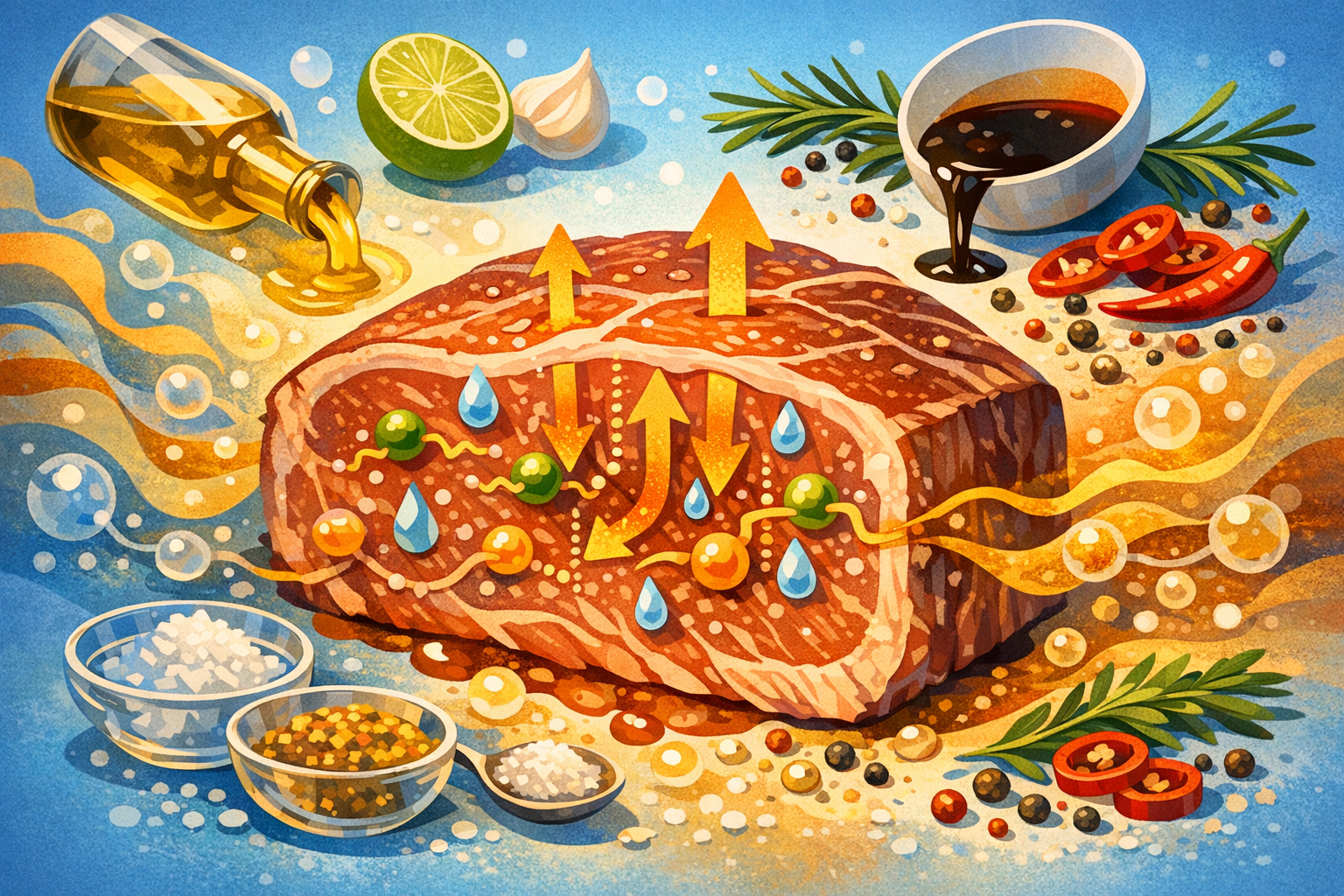
Every backyard cook has a marinade story. Maybe it's the overnight soak that supposedly transformed a cheap steak, or the ziplock bag of Italian dressing that "tenderized" chicken breasts. Marinades are one of the most universally practiced kitchen techniques, yet they're also one of the most misunderstood. The truth about what marinades can and can't do might surprise you, and it will absolutely change how you use them.
The science of marination has been studied extensively by food scientists, and the results challenge decades of conventional wisdom. Understanding what actually happens when food sits in a flavored liquid will make you a better cook, because you'll stop wasting time on techniques that don't work and double down on the ones that do.
The Penetration Problem
Here's the uncomfortable truth that changes everything: marinades barely penetrate the surface of meat. Food scientist Harold McGee has demonstrated that most marinade ingredients only soak in about 1 to 2 millimeters, even after 24 hours. That's roughly the thickness of a coin.
Think about that the next time you leave a pork loin sitting in teriyaki sauce overnight. The center of that meat has absolutely no idea it's been marinating. The flavor is almost entirely on the surface, which is why a well-seared piece of meat that was marinated for 30 minutes often tastes nearly identical to one that soaked for 12 hours.
The reason for this limited penetration comes down to molecular size. Most flavor compounds in a marinade, things like garlic, herbs, soy sauce, and spices, are made up of relatively large molecules. These molecules can coat the surface effectively, but they're simply too big to work their way deep into the dense protein structure of raw meat. Salt and sugar are the notable exceptions, which we'll get to shortly.
What About Thin Cuts?
This is where marination actually shines. When you're working with thin pieces of protein (think skirt steak, chicken tenders, shrimp, or thinly sliced vegetables), a 30-minute marinade can absolutely transform the flavor because the ratio of surface area to volume is much higher. Every bite has proportionally more marinated surface. This is exactly why many Asian cuisines feature thinly sliced, well-marinated proteins in stir-fries. It's not tradition for tradition's sake; it's applied food science.
Acid: The Misunderstood Ingredient
Perhaps the biggest marinade myth is that acidic ingredients like lemon juice, vinegar, wine, and yogurt "tenderize" meat. What they actually do is denature the surface proteins, which means they change the protein structure in a way that initially feels softer but quickly becomes mushy and unpleasant if you go too far.
Picture what happens when you squeeze lime juice over raw fish to make ceviche. The acid "cooks" the exterior by denaturing the proteins, turning them opaque and firm. The exact same process happens when you marinate chicken in lemon juice. Short exposure creates a pleasant, slightly softened texture on the surface. Extended exposure (anything over two hours for most acids) turns the outer layer chalky and grainy while the interior remains completely unchanged.
This is why many classic French marinades use wine as the acid component. Wine is relatively mild compared to citrus juice or vinegar, so the window between "nicely flavored" and "overmarinated" is much wider. If you're using a strong acid like lime juice, keep your marination time to 30 minutes or less. Yogurt is particularly forgiving because lactic acid is a weaker acid, which is one reason why yogurt-based marinades are so common in Indian and Middle Eastern cooking. You can leave chicken in a yogurt marinade for several hours without any negative textural effects.
The pH Sweet Spot
Most effective acidic marinades land in a pH range of 3 to 4. For reference, lemon juice has a pH around 2 (very acidic), white wine vinegar sits around 2.5, and yogurt is closer to 4.5 (mildly acidic). The more acidic your marinade base, the shorter your marination window should be. A good rule of thumb: if you can taste the sourness strongly, keep it brief.
Salt: The Real Hero
If there's one marinade ingredient that deserves star billing, it's salt. Unlike nearly every other component in your marinade, salt actually penetrates deep into the protein structure. It does this through osmosis and diffusion, moving from the high-concentration liquid on the outside to the lower-concentration moisture inside the meat.
Salt does two critical things once it gets inside. First, it seasons the meat throughout, not just on the surface. This is why a properly brined chicken tastes fundamentally different from one that was merely salted before cooking. Second, salt dissolves some of the muscle proteins (specifically myosin), which allows them to hold onto more water during cooking. The result is juicier, more flavorful meat that's seasoned all the way through.
This is essentially the science behind brining, which is really just a very simple marinade of salt and water. A 3 to 5 percent salt solution (about 1 tablespoon of kosher salt per cup of water) will season a chicken breast all the way through in about an hour. A whole turkey might take 12 to 24 hours. Dry brining, where you simply rub salt directly on the surface, achieves similar results but takes a bit longer because the salt needs to dissolve in the meat's own surface moisture before it can begin migrating inward.
Sugar Follows the Same Path
Sugar molecules are small enough to penetrate alongside salt, though more slowly. This is why many effective marinades include some form of sweetness (honey, brown sugar, maple syrup). The sugar doesn't just sit on the surface; it works its way in and contributes to a sense of depth in the final flavor. It also participates in Maillard browning when you cook the protein, creating more complex flavors on the seared exterior.
Enzymes: Nature's Actual Tenderizers
If you want genuine tenderization (not just surface softening from acid), enzymatic marinades are the real deal. Certain fruits contain proteolytic enzymes that actually break down the tough connective tissue in meat. The most commonly used are:
Pineapple contains bromelain, one of the most aggressive meat-digesting enzymes found in food. Fresh pineapple juice will visibly soften meat within 30 minutes. Kiwi fruit contains actinidin, which works more gently but just as effectively given enough time. Papaya contains papain, which is so effective that it's the active ingredient in commercial meat tenderizer powders. Fresh ginger contains zingibain, a protease that works particularly well on collagen.
The catch with enzymatic marinades is that they work fast and are difficult to control. Leaving meat in fresh pineapple juice for more than an hour can turn the surface to mush while the interior remains tough. The enzymes work from the outside in, just like everything else, so you end up with an unpleasant gradient of textures.
The solution is to use enzymatic ingredients as a brief pre-treatment (15 to 30 minutes), not an overnight soak. Korean BBQ traditions demonstrate this brilliantly. Many bulgogi recipes call for a small amount of Asian pear (which contains similar enzymes) grated into the marinade. The pear isn't there primarily for sweetness; it's a precision tenderizing tool used in just the right quantity.
Building a Better Marinade
Now that you understand the science, here's how to build a marinade that actually delivers on its promises. Think of a marinade as having four functional layers:
Layer 1: Salt (the penetrator)
This is your most important ingredient. Use soy sauce, fish sauce, miso paste, or plain kosher salt. This is what will season the interior of your protein. Everything else is surface-level flavor.Layer 2: Fat (the flavor carrier)
Oil serves as a vehicle for fat-soluble flavor compounds. Many of the aromatic molecules in garlic, herbs, and spices are fat-soluble, meaning they dissolve in oil much better than in water or acid. Olive oil, sesame oil, or any neutral oil helps distribute these flavors evenly across the protein's surface.Layer 3: Acid or enzyme (the texture modifier)
Use this judiciously. A small amount of acid brightens flavors and gently softens the surface. Too much, or too long, creates problems. If you're using citrus or vinegar, keep it to 30 minutes. Yogurt and wine give you more flexibility.Layer 4: Aromatics (the surface flavor)
Garlic, ginger, herbs, spices, chili paste, citrus zest. These won't penetrate far, but they create an intensely flavorful crust when the protein is cooked. This is actually where most of the "marinade flavor" you taste comes from, and it doesn't require hours to stick to the surface.Timing Guidelines That Actually Work
Forget the recipes that tell you to marinate overnight "for best results." Here's what the science supports:
Shrimp and fish: 15 to 30 minutes maximum. These proteins are delicate and acid will turn them mushy quickly. The thin flesh means flavors coat effectively in minimal time.
Chicken (boneless): 30 minutes to 2 hours. Salt will penetrate a standard chicken breast in about an hour. Surface flavors attach almost immediately. Beyond 2 hours, acidic marinades start doing textural damage.
Thin-cut red meat (skirt steak, flank steak): 1 to 4 hours. These cuts benefit from the salt penetration and have enough structural integrity to handle longer acid exposure.
Thick-cut red meat (ribeye, pork chops): If you're focused on seasoning, a dry brine with salt for 1 to 12 hours is more effective than a liquid marinade. Surface-flavor marinades need only 30 to 60 minutes.
Vegetables: 15 to 30 minutes. Vegetables are porous and absorb marinades much more readily than meat. Longer than 30 minutes and they start to go limp.
The Temperature Factor
Always marinate in the refrigerator, not on the counter. Aside from the obvious food safety concerns (bacteria multiply rapidly between 40°F and 140°F), cold temperatures slow down the enzymatic and acidic reactions, giving you a wider margin of error. The salt penetration rate is slightly slower in the cold, but the trade-off in safety and control is more than worth it.
One exception to this rule: if you're doing a very brief marinade (under 30 minutes), room temperature is fine and can actually be preferable. The warmer protein will sear better because it doesn't need as much energy to reach browning temperatures.
Putting It All Together
The next time you reach for a marinade recipe, evaluate it through this lens. Does it have enough salt to season the interior? Is the acid quantity controlled for the planned marination time? Are there fat-soluble aromatics paired with an oil to carry them? Is the timing realistic for the cut of protein?
The best marinades in the world's great cooking traditions already follow these principles, even if the cooks who developed them centuries ago couldn't explain the molecular biology. Korean bulgogi uses soy sauce (salt), pear (enzyme), sesame oil (fat), and garlic plus ginger (aromatics). Indian tandoori marinades use yogurt (gentle acid plus fat), salt, and a complex spice blend. Peruvian anticuchos use vinegar (acid), cumin and chili (aromatics), and garlic, with brief marination times.
Stop marinating overnight. Start thinking about what each ingredient in your marinade is actually doing. Your food will taste better for it.