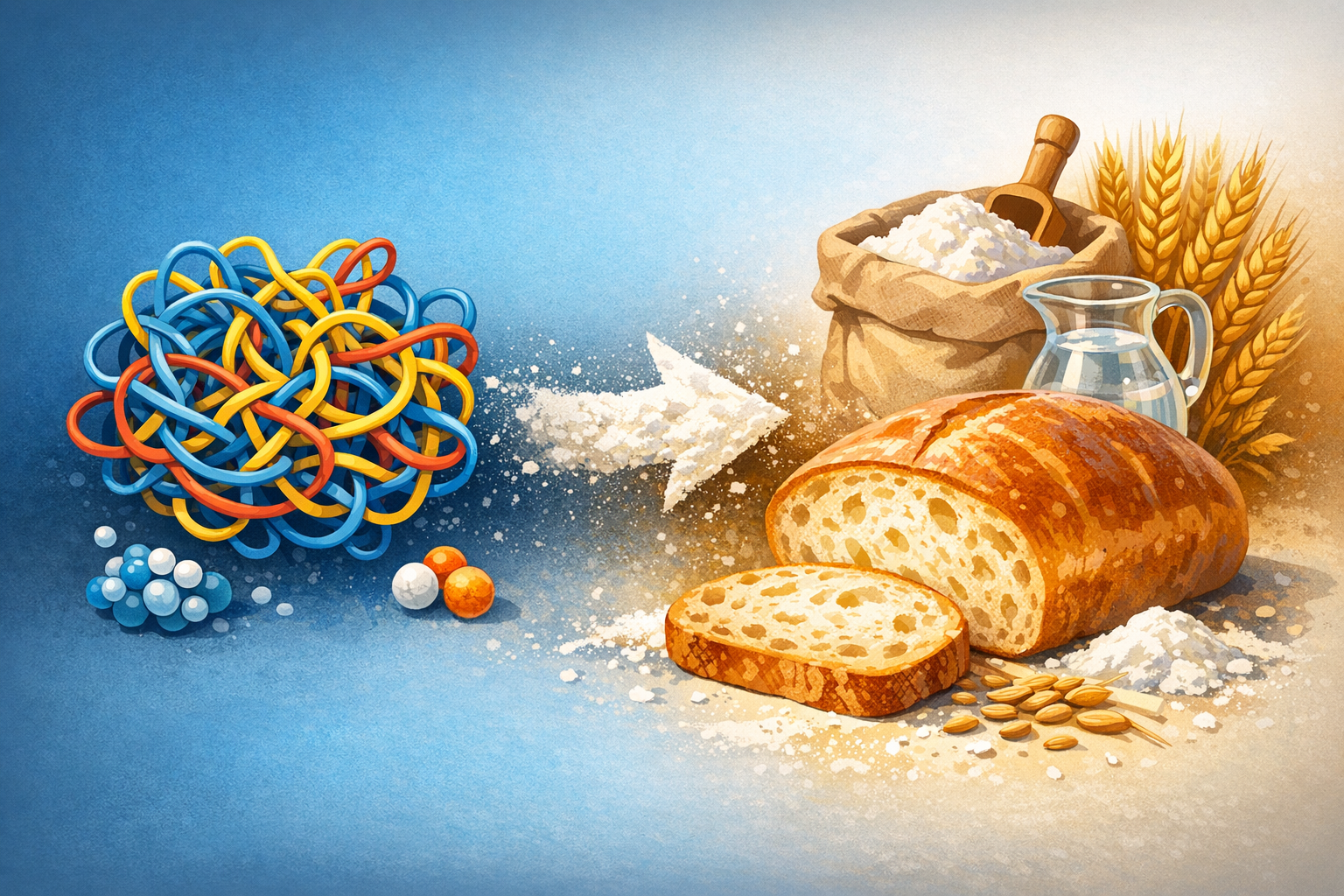
Gluten is the most misunderstood ingredient in cooking. Millions of people avoid it without medical reason, while millions more work with it daily without truly understanding what it is or how it behaves. For bakers, gluten is everything. It's the invisible scaffolding that gives bread its chew, pizza dough its stretch, and croissants their layered architecture. It's also the substance that, when mishandled, turns pie crust into cardboard and cake into rubber.
The difference between a transcendent loaf of bread and a dense, gummy disappointment often comes down to gluten management. Not the amount of gluten in your flour, though that matters, but how you develop it, how long you work it, and when you leave it alone. Once you understand the mechanics, you gain a level of control over baked goods that no recipe can provide on its own.
What Gluten Actually Is
Gluten is not a single substance. It's a composite of two protein families, glutenin and gliadin, that exist separately in dry flour and only form gluten when hydrated.
Glutenin molecules are large, coiled proteins that provide strength and elasticity. Think of them as the load-bearing cables in a suspension bridge. When you stretch bread dough, glutenin is what pulls it back. These proteins form long chains that link together through disulfide bonds, creating a robust network capable of trapping gas and supporting structure.
Gliadin molecules are smaller, more compact, and more mobile. They act as a plasticizer, providing extensibility, which is the ability to stretch without snapping back. If glutenin is the rubber band, gliadin is the taffy. Without gliadin, dough would be impossibly elastic and spring back the moment you tried to shape it. Without glutenin, it would stretch and tear like wet tissue paper.
When flour meets water, these two protein families begin to interact. They unfold from their compact dry state, bond with water molecules, and start linking together into a tangled, three-dimensional mesh. This mesh is gluten. The process is purely mechanical and chemical; no biological agents are required. Yeast, sourdough cultures, and other leavening agents interact with the gluten network after it forms, but they don't create it.
The Role of Water
Water is not just an ingredient in dough; it's the catalyst that makes gluten formation possible. Flour proteins are essentially dormant until they contact liquid. The water molecules insert themselves between the protein chains, allowing them to unfold and begin bonding with each other.
Hydration level dramatically affects gluten development. A stiff dough at 55% hydration (55 grams of water per 100 grams of flour) develops a tight, dense gluten network suitable for pasta. A slack dough at 75% hydration produces an open, extensible network ideal for ciabatta or focaccia. At very high hydration levels (80% and above), the excess water creates large, irregular air pockets and a custardy, translucent crumb.
The temperature of the water matters too. Warm water (around 80-85°F) accelerates gluten hydration and yeast activity simultaneously. Cold water slows both processes, which is why many professional bakers use ice water for pastry doughs. The slower gluten development gives them more time to work the dough before it becomes tough.
Developing Gluten: Kneading and Beyond
Once gluten has formed through hydration, mechanical action organizes and strengthens it. This is where kneading enters the picture.
Kneading does two things at a molecular level. First, it unfolds protein chains that are still partially coiled, exposing more bonding sites and allowing the network to grow. Second, it aligns the tangled protein strands into a more organized, parallel arrangement, like combing tangled hair. This alignment is what gives well-kneaded dough its smooth, satiny surface and its ability to stretch into a thin, translucent sheet (the windowpane test).
Traditional hand kneading takes 10 to 15 minutes for a standard bread dough. Stand mixers accomplish the same development in 6 to 8 minutes at medium speed. But there's a third approach that requires no kneading at all.
Autolyse and Time-Based Development
In 1974, French baking professor Raymond Calvel introduced the autolyse technique: mix flour and water, then let the mixture rest for 20 to 60 minutes before adding salt and yeast. During this rest, enzymes in the flour (particularly protease enzymes) begin gently breaking down proteins, while the proteins simultaneously hydrate and start forming gluten bonds on their own.
The result is a dough that requires significantly less kneading to reach full development. The autolyse period does much of the organizational work passively, reducing mixing time by 30% to 50%. This matters because excessive mixing oxidizes the dough, bleaching its color and stripping flavor compounds. Calvel developed the technique specifically to combat the over-mixed, white, flavorless bread that industrial bakeries were producing.
The no-knead bread revolution, popularized by Jim Lahey and Mark Bittman in 2006, takes this concept to its logical extreme. By using a very wet dough (about 80% hydration) and an extremely long fermentation time (12 to 18 hours), gluten develops entirely through hydration and the gentle stretching action of fermenting gas bubbles. The result is bread with a remarkably open crumb and complex flavor, produced with about 30 seconds of actual hands-on mixing.
Stretch and Fold: The Middle Path
Many artisan bread recipes now replace traditional kneading with a series of stretch-and-fold maneuvers performed during bulk fermentation. Every 30 to 45 minutes, you grab one edge of the dough, stretch it upward, and fold it over the top. Rotate the bowl 90 degrees and repeat, performing four folds total. This takes about 20 seconds.
Three to four rounds of stretch-and-fold over two hours develops gluten thoroughly while incorporating minimal oxygen. The dough transforms from a shaggy, sticky mess into a smooth, billowy mass with visible structure. This approach works especially well for high-hydration doughs that would be difficult to knead on a countertop without adding excessive flour.
When You Don't Want Gluten: Tender Baked Goods
Everything discussed so far applies to bread, where strong gluten is desirable. But for cakes, cookies, muffins, biscuits, pie crusts, and other tender baked goods, gluten is the enemy. Excess gluten development turns these items tough, chewy, and dense.
The strategies for minimizing gluten all target the same mechanism: reducing protein interaction.
Flour Selection
Different wheat varieties contain different amounts of protein. Hard winter wheat, milled into bread flour, contains 12% to 14% protein. Soft winter wheat, milled into cake flour, contains only 7% to 9%. All-purpose flour sits in the middle at roughly 10% to 12%.
Using cake flour for tender applications means there's simply less protein available to form gluten. But protein content isn't the whole story. Cake flour is also chlorinated (treated with chlorine gas), which modifies the starch granules so they absorb more liquid and set faster in the oven. This allows cake batter to support more sugar and fat, both of which further inhibit gluten.
Fat as a Gluten Inhibitor
Fat physically interferes with gluten formation by coating flour proteins and preventing them from bonding with water. This is why enriched doughs (brioche, challah) containing butter, eggs, and sugar are softer and more tender than lean doughs made with just flour, water, salt, and yeast.
In pie crust, the role of fat is even more critical. Cold butter is cut into flour in small pieces, creating a heterogeneous mixture where some flour particles are coated in fat (and therefore can't form gluten) while others remain uncoated (and provide just enough structure to hold the crust together). The coated particles become the tender, flaky layers. The uncoated particles form the minimal gluten network that keeps the crust from crumbling into sand.
This is why pie crust recipes insist on cold butter and minimal mixing. Warm butter melts and spreads, coating too much flour and producing a greasy, crumbly crust. Over-mixing develops too much gluten in the uncoated flour, producing a tough, chewy crust. The ideal is a balance: enough structure to hold together, enough fat coating to stay tender.
Sugar's Effect
Sugar competes with flour proteins for available water. In a cookie dough with high sugar content, much of the water is bound up in sugar solution, leaving less available for gluten hydration. This is one reason cookies are tender rather than chewy (though some cookies, like New York-style chocolate chip cookies, deliberately develop more gluten for a chewier texture by using bread flour and minimal mixing rest time).
Acid and Gluten
Acidic ingredients weaken gluten bonds. This is partly why buttermilk biscuits and pancakes are so tender. The lactic acid in buttermilk interferes with gluten cross-linking, producing a softer, more delicate crumb. Adding a tablespoon of vinegar or lemon juice to pie crust dough serves the same purpose, making the dough easier to roll out while keeping the baked crust flaky.
Gluten and Resting: Why Patience Pays
Anyone who has tried to roll out pizza dough knows the frustration: you stretch it, it springs back. You stretch again, it shrinks again. The solution is simple but counterintuitive: walk away.
When you work dough, you're stretching the gluten network and creating tension in the protein bonds. The elastic glutenin proteins want to return to their relaxed state, so they pull the dough back. If you keep fighting against this tension, you'll exhaust yourself before the dough gives in.
Resting allows the gluten to relax. Over 10 to 20 minutes, the stressed protein bonds gradually release their tension and settle into a new equilibrium. When you return to the dough, it stretches much more willingly. This is called gluten relaxation, and it's the reason nearly every bread recipe includes a rest period between shaping steps.
The same principle applies to pasta. After mixing and kneading, pasta dough should rest for at least 30 minutes before rolling. Without this rest, the dough resists the rollers and tears. After resting, it feeds through smoothly and can be rolled tissue-thin without breaking.
Troubleshooting Common Gluten Problems
Dense, Heavy Bread
Usually caused by insufficient gluten development. The network isn't strong enough to trap the gas produced by yeast, so bubbles escape and the bread stays flat. Solutions: knead longer, use bread flour instead of all-purpose, ensure adequate hydration (dry dough resists gluten development), and give the dough enough time to rise.
Bread That Rises Then Collapses
Often caused by over-proofing, where the yeast produces so much gas that the gluten network stretches beyond its capacity and ruptures. The structure literally tears apart from the inside. Solutions: proof for less time, use a cooler proofing temperature, or reduce the amount of yeast slightly.
Tough Muffins or Quick Breads
Almost always caused by over-mixing the batter. Quick bread batters should be mixed only until the dry ingredients are moistened. Lumps are acceptable and even desirable. Every additional stir develops more gluten. The classic instruction to "mix until just combined" is not a suggestion; it's the most important step in the recipe.
Pie Crust That Shrinks in the Oven
Caused by gluten that was developed during rolling and hasn't had time to relax. When the crust heats up, the stretched gluten proteins contract, pulling the crust away from the edges of the pan. Solutions: rest the rolled crust in the refrigerator for at least 30 minutes before baking, and avoid stretching the dough when fitting it into the pan (lift and settle it in, rather than pushing it against the sides).
Understanding gluten transforms baking from recipe-following into actual cooking. When you know what's happening inside your dough, you can adapt to different flours, different humidity levels, and different recipes with confidence. The protein network is doing the real work. Your job is to give it the right conditions and get out of its way.